
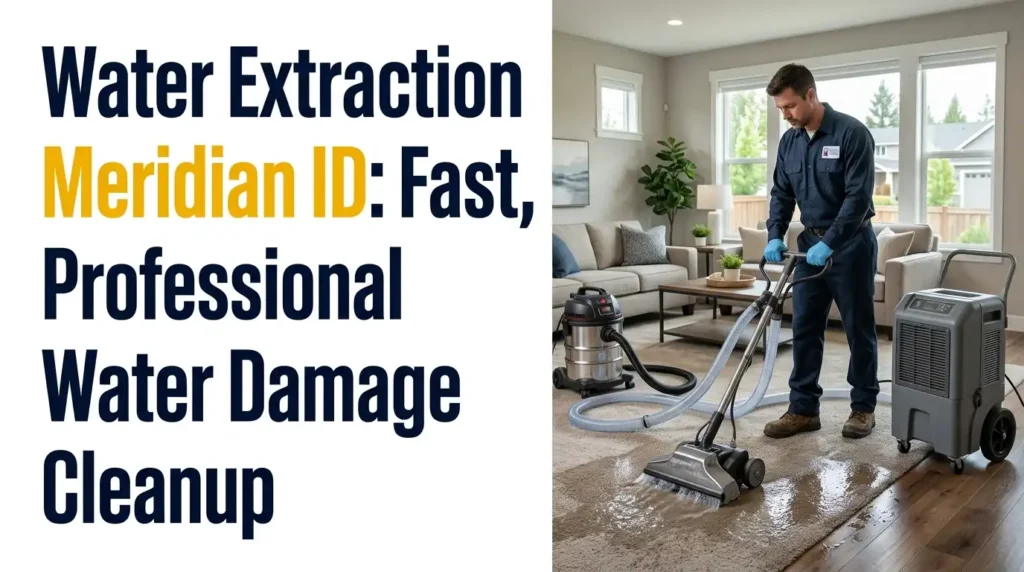
A crack just 1/8 inch wide in a supply line can release up to 250 gallons of water a day. That water soaks into carpet pads, drywall, and subfloors within minutes. Fast water extraction Meridian ID homeowners can count on is what separates a weekend repair from a gutted room. The clock starts the moment water hits the floor. Mold can begin growing in as little as 24 to 48 hours, and every hour of delay raises your repair bill and your health risk.
Key Takeaways
- Stop the source first. Shut off your main water valve and call a plumber before you start any cleanup.
- You have 24 to 48 hours. The EPA says homes not dried in that window should be treated as if mold is already growing.
- Water type changes everything. Clean supply-line water (Category 1) can be handled fast. Sewage (Category 3) needs professional extraction and disinfection.
What Is Water Extraction?
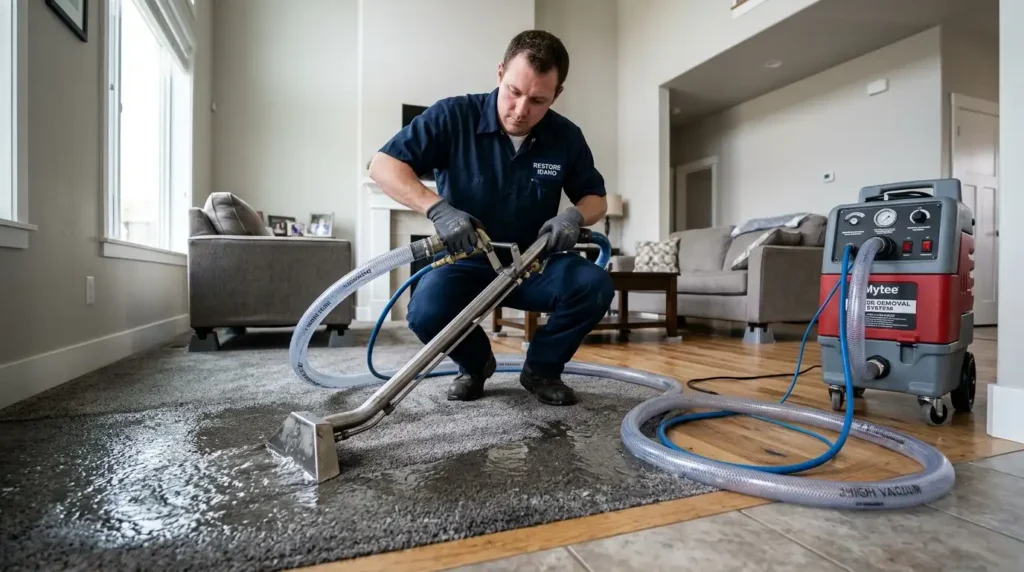
Water extraction is the removal of standing and absorbed water from your home. It is the first phase of water damage mitigation (the work done to limit further damage). Crews use truck-mounted pumps, weighted extraction wands, and submersible pumps to pull water out of carpet, pad, and concrete.
Extraction is not the same as drying. Extraction removes liquid water. Structural drying removes moisture trapped inside wood, drywall, and concrete using dehumidifiers and air movers. You need both.
On recent service calls in Meridian, we found that homeowners who called an emergency plumber within the first hour saved thousands of dollars in tear-out costs. Fast response limits how far water wicks (climbs up through porous materials like drywall). Your first move is always the same: find your main shutoff valve before you ever need it.
Why Speed Matters: Response Time vs. Damage Severity
Speed matters because water spreads, soaks, and contaminates over time. The EPA’s Homeowner’s and Renter’s Guide to Mold Cleanup After Disasters states that if you can’t dry your home within 24 to 48 hours, you should assume mold growth. Here is what we see in the field at each stage.
| Time Since Water Loss | What’s Happening | Typical Damage | Likely Outcome |
|---|---|---|---|
| 0 to 1 hour | Water spreads across floors, into baseboards | Surface wetting | Extraction only, minimal tear-out |
| 1 to 24 hours | Drywall wicks water upward; carpet pad saturates | Swelling furniture, stained drywall | Extraction plus pad removal |
| 24 to 48 hours | Odors start; clean water begins to degrade | Delaminating carpet, warped trim | Mold risk begins; partial drywall cuts |
| 48 to 72 hours | Mold colonies form on organic materials | Musty smell, visible spotting | Mold remediation likely |
| 1 week+ | Structural rot, widespread mold | Subfloor, framing, insulation damage | Major reconstruction |
Bookmark this table and keep your plumber’s number saved in your phone today.
Common Causes of Water Damage in Meridian, ID
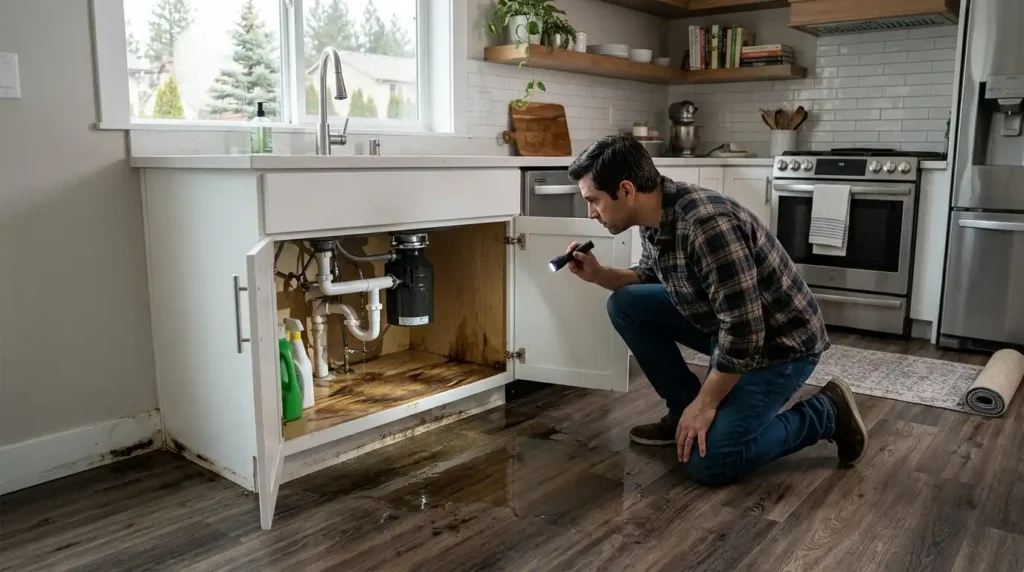
Most water damage in Meridian starts with a plumbing failure, not a flood. The Treasure Valley’s cold winters, hard water, and pressurized irrigation systems create a predictable pattern of losses. Our crews track these trends every season.
| Cause | Peak Season | Warning Signs | Typical Water Category |
|---|---|---|---|
| Frozen/burst pipes | December to February | No water at faucet, frost on pipes, bulging lines | Category 1 |
| Water heater failure | Year-round (worse with hard water) | Rust-colored water, popping sounds, pooling at base | Category 1 |
| Washing machine hose burst | Year-round | Bulging or cracked rubber hoses | Category 2 |
| Dishwasher/fridge line leak | Year-round | Warped flooring near appliance | Category 1 to 2 |
| Toilet overflow | Year-round | Slow flush, running water | Category 2 to 3 |
| Sewer backup | Spring and heavy-use periods | Gurgling drains, sewage odor, multiple slow drains | Category 3 |
| Irrigation line leak | April to October | Soggy yard near foundation, wet crawl space | Category 2 |
Frozen and Burst Pipes
Frozen pipes are the top cause of winter water extraction Meridian ID calls we handle. Water expands about 9% when it freezes, which builds pressure inside the line. The pipe often splits where it’s weakest, but the leak doesn’t show until the thaw.
If you’ve spent a winter in Idaho, protecting your pipes makes complete sense. Our plumbers frequently see this in older Boise homes with uninsulated crawl spaces and exterior-wall plumbing. A single cold snap in January can produce a week’s worth of emergency calls.
Appliance Failures
Appliance failures cause sudden, high-volume leaks. Water heaters in the Treasure Valley often fail sooner than the national 8 to 12 year average because hard water builds scale on the tank bottom. That scale traps heat, stresses the steel, and leads to tank ruptures.
Washing machine hoses are another frequent culprit. Rubber hoses crack with age. Swap them for braided stainless steel hoses every five years.
Sewer Backups
Sewer backups are the most dangerous water loss. The water carries bacteria, viruses, and parasites. The EPA warns that flood and sewage water can expose your family to serious health hazards, so this is never a DIY job.
Irrigation Leaks
Meridian’s pressurized irrigation systems run under high pressure from spring through fall. A cracked line near your foundation can push water into crawl spaces and basements for weeks before anyone notices. Check your crawl space at least once each irrigation season.
Walk your home this week and note the age of every water heater, supply hose, and exposed pipe.
Also Check – Water Heater Replacement Middleton: What Hard Water and Idaho Winters Mean for Your Next Tank
IICRC Water Damage Categories and Classes
The IICRC sets the industry standard for water damage restoration. The IICRC (Institute of Inspection, Cleaning and Restoration Certification) publishes the S500 standard, which every reputable crew follows. It rates water two ways: by contamination (Category) and by how much material is wet (Class).
Water Categories (Contamination Level)
Category tells you how dirty the water is. This decides whether materials can be saved or must be thrown out.
| Category | Description | Common Meridian Sources | Can Carpet Be Saved? |
|---|---|---|---|
| Category 1: Clean Water | Sanitary source, no immediate health risk | Burst supply line, water heater, fridge line | Usually yes, if extracted fast |
| Category 2: Gray Water | Significant contamination; can cause illness | Washing machine, dishwasher, toilet overflow (urine only) | Carpet sometimes; pad no |
| Category 3: Black Water | Grossly contaminated; pathogens present | Sewer backup, toilet with feces, outdoor floodwater | No, discard porous materials |
Water categories get worse over time. Category 1 water can degrade to Category 2 within about 48 hours as bacteria multiply. Clean water does not stay clean once it sits in a warm house.
Water Classes (Evaporation Load)
Class tells you how much water soaked in and how hard drying will be. The 2021 update to the S500 standard bases class on the percentage of wet surface area and the porosity of materials.
| Class | Wet Surface Area | Materials Affected | Drying Difficulty | Typical Drying Time |
|---|---|---|---|---|
| Class 1 | Less than 5% | Small area, low-porosity materials | Low | 1 to 2 days |
| Class 2 | 5% to 40% | Carpet, pad, lower walls | Moderate | 2 to 4 days |
| Class 3 | More than 40% | Ceilings, walls, insulation, subfloor | High | 3 to 5+ days |
| Class 4 | Varies | Hardwood, concrete, plaster, crawl spaces (deeply bound water) | Specialty drying | 5 to 14+ days |
Ask any crew you hire which Category and Class they assigned to your loss, and get it in writing.
The Professional Water Extraction Process, Step by Step
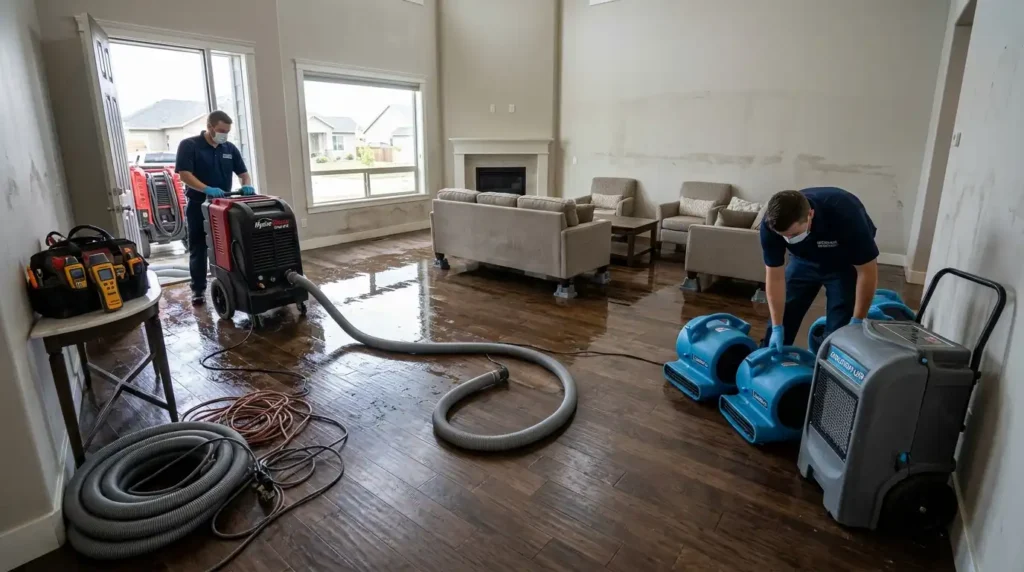
Professional extraction follows a fixed sequence. Each step builds on the last, and skipping one leads to hidden moisture, mold, or denied insurance claims. Here’s how a proper job runs.
- Stop the water source. A plumber shuts off the supply and repairs the burst pipe, failed valve, or broken appliance line.
- Assess safety hazards. The crew checks for electrical risks, sagging ceilings, and gas leaks before entering wet areas.
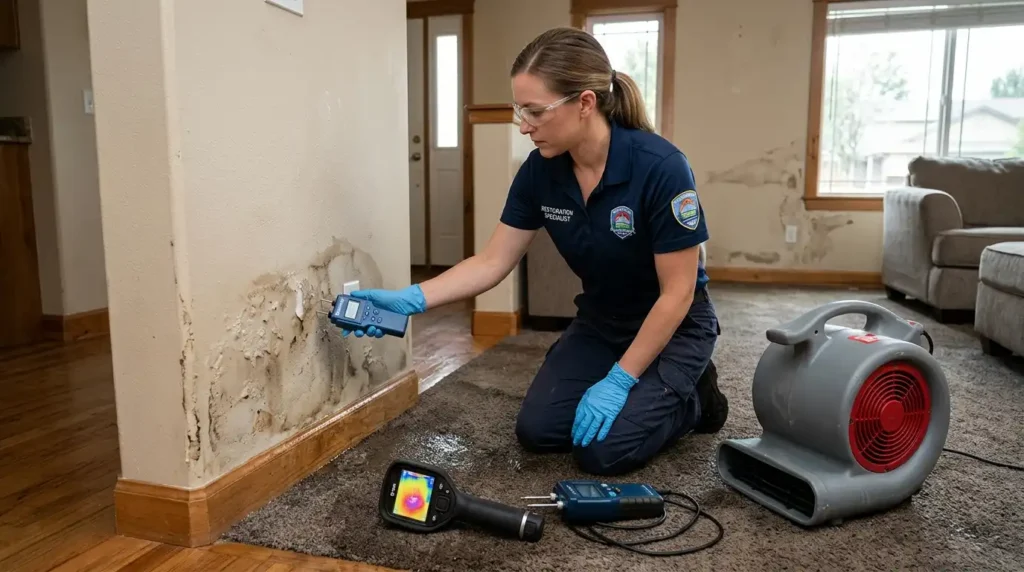
- Identify category and class. Technicians test the water source and map the wet area with moisture meters and thermal imaging cameras.
- Document everything. Photos, video, and moisture readings go into a file for your insurance claim.
- Extract standing water. Truck-mounted units and submersible pumps remove bulk water. This step alone removes far more water than drying ever will.
- Extract from carpet and pad. Weighted extraction tools (rollers or stand-on wands) squeeze water out of carpet and pad.
- Remove unsalvageable materials. Wet carpet pad, saturated drywall, and wet insulation come out. FEMA recommends cutting drywall at least 12 inches above the water line.
- Clean and disinfect. Crews apply antimicrobial treatments to affected surfaces, especially in Category 2 and 3 losses.
- Set drying equipment. Air movers, LGR dehumidifiers (low-grain refrigerant units that pull more moisture from air), and wall cavity dryers go in.
- Monitor daily. Technicians take readings every 24 hours and adjust equipment until materials reach the dry standard.
Steps 5 and 6 matter most. Removing liquid water is far faster than evaporating it. Ask your crew how many gallons they extracted before the fans went in.
What to Do in the First 60 Minutes
Your actions in the first hour decide how much of your home you save. Follow these steps in order. Safety comes before speed.
Emergency Troubleshooting Steps
- Shut off the main water valve. In most Meridian homes, it’s in the garage, utility closet, or a crawl space near the front of the house.
- Turn off power to wet areas. Flip the breaker only if you can reach the electrical panel without standing in water.
- Call a plumber. Get the leak fixed so extraction isn’t wasted effort.
- Photograph the damage. Take wide shots and close-ups before you move anything.
- Move valuables. Lift furniture onto aluminum foil or wood blocks to stop stains and wicking.
- Remove small rugs and textiles. Hang them to dry in a garage or outdoors.
- Open cabinets and closet doors. The EPA recommends opening interior doors and drawers to improve airflow.
- Call your insurance company. Report the loss the same day.
PPE Checklist for Any Cleanup
The EPA recommends specific protective equipment for flood and mold cleanup. Don’t touch Category 2 or 3 water without it.
- N-95 respirator at minimum (half-face or full-face for longer work)
- Non-latex gloves (nitrile, vinyl, or rubber)
- Sealed goggles without vent holes
- Rubber boots with good tread
- Long sleeves and pants you can wash or throw away
Keep children and anyone with asthma or a weakened immune system out of the work area. Put a basic PPE kit next to your shutoff valve so it’s ready when you need it.
Also Check – Burst Pipe Repair Meridian ID: How to Stop the Damage and Fix It Right
DIY vs. Professional Water Extraction
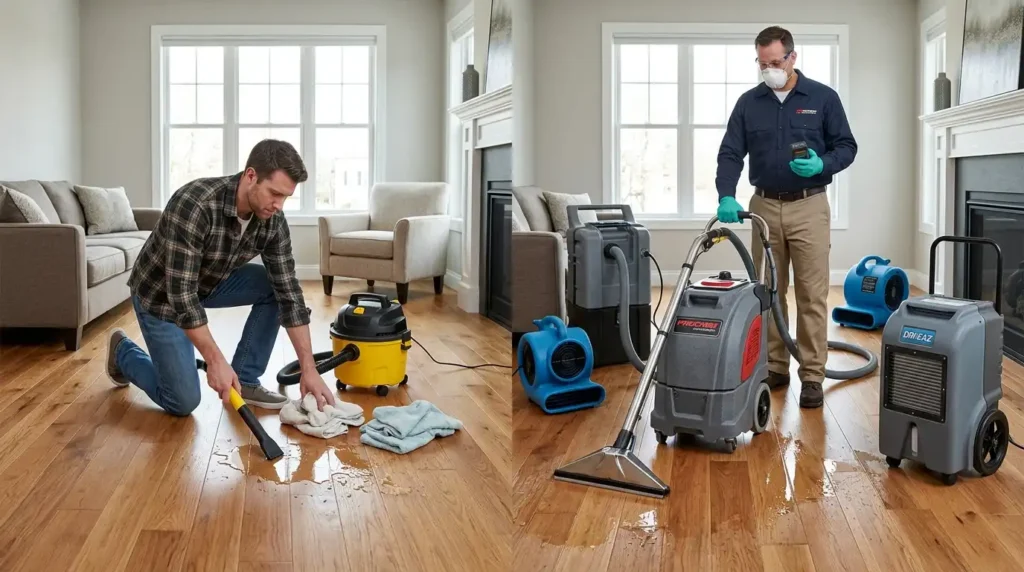
DIY extraction works only for small, clean-water spills. A shop vacuum can handle a few gallons on tile. It cannot pull water from carpet pad, wall cavities, or subfloors.
| Factor | DIY Extraction | Professional Extraction |
|---|---|---|
| Best for | Under 10 sq ft, Category 1 only | Any size, any category |
| Equipment | Shop vac, box fans, towels | Truck mounts, LGR dehumidifiers, air movers |
| Water removal rate | A few gallons at a time | Hundreds of gallons per hour |
| Hidden moisture detection | None (guesswork) | Moisture meters, thermal imaging |
| Contaminated water | Unsafe | Disinfection and PPE included |
| Insurance documentation | Your photos only | Daily drying logs and moisture maps |
| Mold risk | High if drying is incomplete | Low with verified dry standard |
| Upfront cost | $0 to $300 (rentals) | Several hundred to several thousand dollars |
DIY Pros and Cons
Pros:
- Low upfront cost for very small spills
- Immediate start while you wait for help
- Works well on tile, vinyl, and sealed concrete
Cons:
- Misses trapped moisture inside walls and under floors
- Box fans can spread mold spores if growth has started
- No documentation for insurance
- Unsafe for gray or black water
Professional Pros and Cons
Pros:
- Fast, complete removal with commercial equipment
- Verified dry standard before rebuild
- Insurance-ready reports
- Proper disinfection for contaminated water
Cons:
- Higher upfront cost (often covered by insurance)
- Equipment noise for 3 to 5 days
- Some tear-out may be required
Our rule of thumb is simple. If water touched carpet, crossed into another room, or came from a drain, you need professional water extraction Meridian ID crews, not a shop vac.
Water Extraction Cost in Meridian, ID
Water extraction cost depends on square footage, water category, and drying time. The ranges below reflect typical Treasure Valley pricing. Your final quote depends on the specific materials and access in your home.
Cost by Square Footage and Category
| Affected Area | Category 1 (Clean) | Category 2 (Gray) | Category 3 (Black) |
|---|---|---|---|
| Small (under 100 sq ft) | $300 to $800 | $500 to $1,200 | $1,000 to $2,500 |
| Medium (100 to 500 sq ft) | $800 to $2,500 | $1,200 to $3,500 | $2,500 to $6,000 |
| Large (500 to 1,000 sq ft) | $2,500 to $5,000 | $3,500 to $7,000 | $6,000 to $12,000 |
| Whole floor (1,000+ sq ft) | $5,000+ | $7,000+ | $12,000+ |
Cost by Drying Equipment and Time
| Equipment | Typical Daily Rate | Typical Days Needed |
|---|---|---|
| Air mover | $25 to $50 per unit | 3 to 5 |
| LGR dehumidifier | $75 to $150 per unit | 3 to 5 |
| Wall cavity dryer | $50 to $100 per unit | 2 to 4 |
| Antimicrobial treatment | $0.50 to $2 per sq ft (one-time) | N/A |
| Daily monitoring visit | Often included | Every 24 hours |
What Drives Your Price Up
- Delayed response: Water that sits longer than 48 hours requires more tear-out.
- Contaminated water: Category 3 losses require disposal, disinfection, and full PPE.
- Hardwood floors: These need specialty drying mats and longer timelines.
- Crawl spaces: Tight access adds labor time and specialty equipment.
- After-hours calls: Nights and weekends can carry an emergency rate.
Ask for a written estimate that lists equipment counts, daily rates, and expected drying days before work begins.
When to Call a Plumber vs. a Restoration Company
A plumber stops the water; a restoration company dries the structure. Most losses need both, and the order matters. Extracting water from a home with an active leak wastes time and money.
| Situation | Call a Plumber First | Call a Restoration Company |
|---|---|---|
| Burst or leaking pipe | Yes, stop and repair | After the leak is fixed |
| Water heater rupture | Yes, shut off and replace | If water spread beyond the utility area |
| Sewer backup | Yes, clear the line | Yes, for Category 3 cleanup |
| Unknown leak source | Yes, for leak detection | After the source is found |
| Small spill, source known | Only if plumbing failed | Usually not needed |
| Roof or storm leak | No | Yes, plus a roofer |
| Whole-floor flooding | Yes | Yes |
At Meridian Plumbing Services, we stop the source, make the repair, and help you get standing water out fast. Hidden leaks are a common reason water keeps returning after cleanup. Our leak detection service uses acoustic sensors and thermal imaging to find leaks inside walls, slabs, and ceilings without tearing everything open. For large Class 3 or Category 3 losses, we coordinate with IICRC-certified restoration partners so your project stays on track.
Before any drying equipment goes in, confirm the leak source has been found and repaired.
Idaho-Specific Water Damage Risks
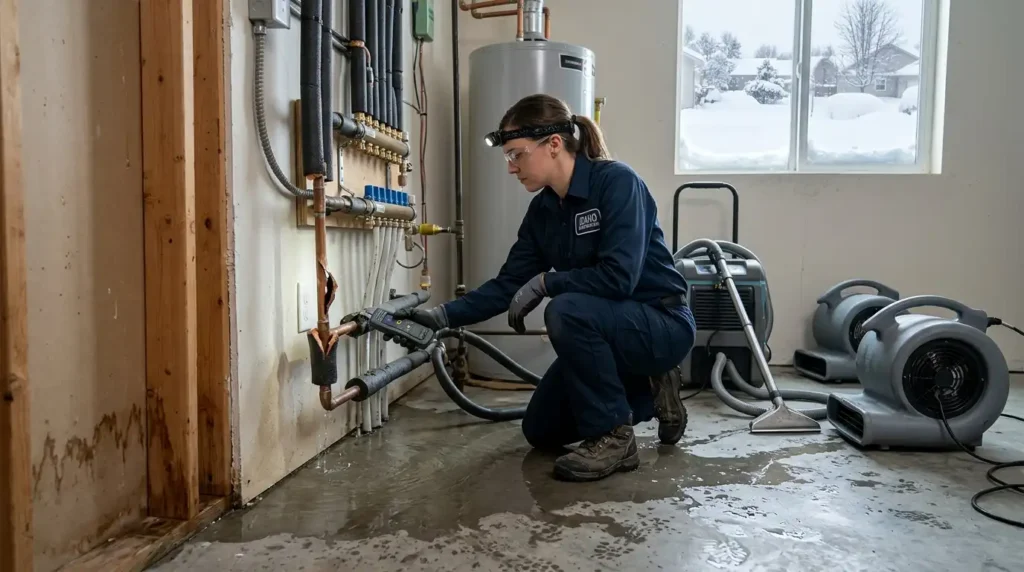
The Treasure Valley has its own set of water damage risks. Hard water, freezing winters, crawl space construction, and irrigation systems all shape how water extraction Meridian ID jobs play out. Understanding these helps you prevent losses before they start.
| Local Risk | Why It Happens Here | What It Damages | Prevention Step |
|---|---|---|---|
| Hard water scale | High mineral content in local groundwater | Water heaters, valves, supply lines, fixtures | Flush water heater yearly; consider a softener |
| Winter freezes | Overnight lows well below freezing in winter | Exterior-wall pipes, hose bibs, crawl space lines | Insulate pipes; disconnect hoses by October |
| Crawl space moisture | Common in older Boise and Meridian homes | Joists, subfloor, insulation | Vapor barrier; seasonal inspections |
| Pressurized irrigation | High-pressure lines near foundations | Crawl spaces, basements, landscaping | Winterize lines before the first freeze |
| Aging sewer laterals | Older clay and cast iron lines in established neighborhoods | Basements, lower-level bathrooms | Camera inspection every few years |
Hard Water and Hidden Leaks
Hard water quietly shortens the life of your plumbing. Minerals collect inside valves, water heater tanks, and supply lines. Over time, scale causes valves to stick and fittings to fail. Many of our winter leak calls start with a fitting weakened by years of scale.
Winter Freezes and Crawl Spaces
Crawl spaces are the weak point in many Treasure Valley homes. Cold air moves in through foundation vents and freezes unprotected pipes. Close foundation vents in late fall and add foam pipe insulation or heat tape to exposed lines.
Schedule a fall plumbing inspection before the first hard freeze hits.
Insurance Documentation Tips
Good documentation speeds up your claim and protects your payout. Insurers want proof of the cause, the extent, and the steps you took to limit damage. Most homeowners policies cover sudden and accidental water discharge but exclude gradual leaks and outside flooding (which needs separate flood insurance).
Insurance Documentation Checklist
- Photograph the source: the burst pipe, failed hose, or backed-up drain
- Shoot wide and close: room overviews plus close-ups of damaged items
- Record video: walk through every affected room with narration
- Keep damaged parts: save the failed pipe section or hose for the adjuster
- Save every receipt: plumbing repairs, equipment rentals, hotel stays
- Request drying logs: daily moisture readings prove the work was necessary
- Note the timeline: write down when you found the leak and who you called
- Don’t throw out big items until the adjuster approves it, unless they pose a health risk
Mitigation Duty
Your policy requires you to prevent further damage. This is called your duty to mitigate. Waiting days to start water extraction can give your insurer a reason to reduce your claim. Call your agent within 24 hours and ask for your claim number in writing.
Post-Extraction Structural Drying and Monitoring
Structural drying removes the moisture you can’t see. After extraction, water remains trapped inside wood framing, drywall, subfloor, and concrete. Drying is finished only when materials match the dry standard (the moisture level of similar, unaffected materials in your home).
Drying Targets and Monitoring
| Material | How It’s Measured | Drying Goal | Common Problem If Rushed |
|---|---|---|---|
| Drywall | Pin or pinless moisture meter | Matches unaffected walls | Mold behind paint, crumbling |
| Wood framing | Pin moisture meter | Matches dry reference framing | Rot, warping, mold |
| Subfloor | Pin meter, thermal camera | Matches dry areas of the home | Squeaks, cupping, delamination |
| Hardwood floors | Specialty meter, drying mats | Within a few points of dry wood | Cupping and crowning |
| Concrete slab | Surface and in-slab readings | Matches dry slab areas | Flooring adhesive failure |
| Indoor air | Thermo-hygrometer | 30% to 50% relative humidity | Condensation, ongoing mold risk |
What Daily Monitoring Looks Like
- Take readings at the same marked points every 24 hours.
- Log the numbers on a drying chart.
- Adjust equipment by moving air movers to the wettest zones.
- Remove equipment only after readings hit the dry standard.
- Check again 48 hours after equipment leaves.
FEMA advises letting wet areas dry completely, usually two to three days at minimum, before you rebuild. Idaho’s dry climate helps, but don’t let it fool you. Surface-dry is not the same as structurally dry. Ask for a final moisture report before drywall or flooring goes back in.
Prevention Maintenance Checklist
Prevention costs a fraction of extraction. Most of the water losses we see could have been caught early with routine checks. Use this checklist to protect your home year-round.
Seasonal Plumbing Checklist
Fall (September to November):
- Winterize irrigation lines and blow out sprinkler systems
- Disconnect garden hoses and install frost-free hose bib covers
- Close crawl space vents and check pipe insulation
- Flush your water heater to clear hard water sediment
Winter (December to February):
- Keep the thermostat at 55°F or higher, even when traveling
- Open sink cabinets on exterior walls during cold snaps
- Drip faucets on the coldest nights
Spring (March to May):
- Inspect for winter damage in crawl spaces and attics
- Test your sump pump if you have one
- Check irrigation lines for leaks at startup
Year-Round:
- Replace washing machine hoses every five years
- Install water leak sensors near appliances
- Know your shutoff valve location and test it twice a year
- Watch for slow drains, which often signal a developing sewer clog
Slow drains deserve special attention. A partial clog in your main sewer line can turn into a Category 3 backup overnight. Professional drain cleaning with hydro jetting and camera inspection clears roots and grease before they cause a disaster. That one visit can prevent the most expensive type of water extraction Meridian ID homeowners ever face.
Pick one item from this checklist and finish it this weekend.
Faqs:
1. How fast should water extraction start?
Water extraction should start within the first few hours. The EPA’s guidance sets a 24 to 48 hour window to dry your home before you should assume mold is growing. The sooner extraction begins, the more drywall, carpet, and flooring you save.
2. Can I use a shop vac for water extraction?
A shop vac works only for small, clean-water spills on hard surfaces. It cannot pull water out of carpet pad, walls, or subfloors. Anything larger than a small puddle or any gray or black water needs professional equipment.
3. How long does water extraction and drying take in Meridian?
Extraction itself usually takes a few hours. Structural drying typically runs 3 to 5 days for most residential losses. Hardwood floors, crawl spaces, and Class 4 losses can take one to two weeks.
4. Does homeowners insurance cover water extraction Meridian ID claims?
Most policies cover sudden and accidental water damage, like a burst pipe or a failed water heater. They usually exclude gradual leaks, poor maintenance, and outside flooding. Review your policy and call your agent as soon as you find the damage.
5. Can wet carpet be saved?
Wet carpet can often be saved after a Category 1 loss if extraction starts quickly. The pad underneath is usually replaced because it holds water like a sponge. Carpet soaked by sewage or floodwater must be discarded, and FEMA advises throwing out soaked carpeting after floods.
6. How do I know if mold is growing after a leak?
Watch for a musty odor, discoloration on walls, or worsening allergy symptoms. The EPA notes that mold often hides behind drywall, under carpet, and inside cushions. If you still smell mold after cleanup, the job isn’t finished.
7. Should I call a plumber or a restoration company first?
Call a plumber first if the water came from a pipe, appliance, fixture, or drain. Extraction can’t succeed while water is still flowing. Once the source is fixed, drying crews can finish the job.
Get Fast Water Extraction in Meridian, ID
Every hour counts when water hits your floors. Our team at Meridian Plumbing Services answers calls 7 days a week across Meridian, Boise, Nampa, and the entire Treasure Valley. We stop the leak, repair the plumbing, and get your water extraction Meridian ID project moving with transparent pricing and plain-language explanations.
Your next three steps:
- Find your main shutoff valve today and label it.
- Save our number in your phone for after-hours emergencies.
- Call us now if you see standing water, hear dripping in a wall, or smell sewage.
Contact Meridian Plumbing Services for fast, honest help from local plumbers who know Idaho homes.