
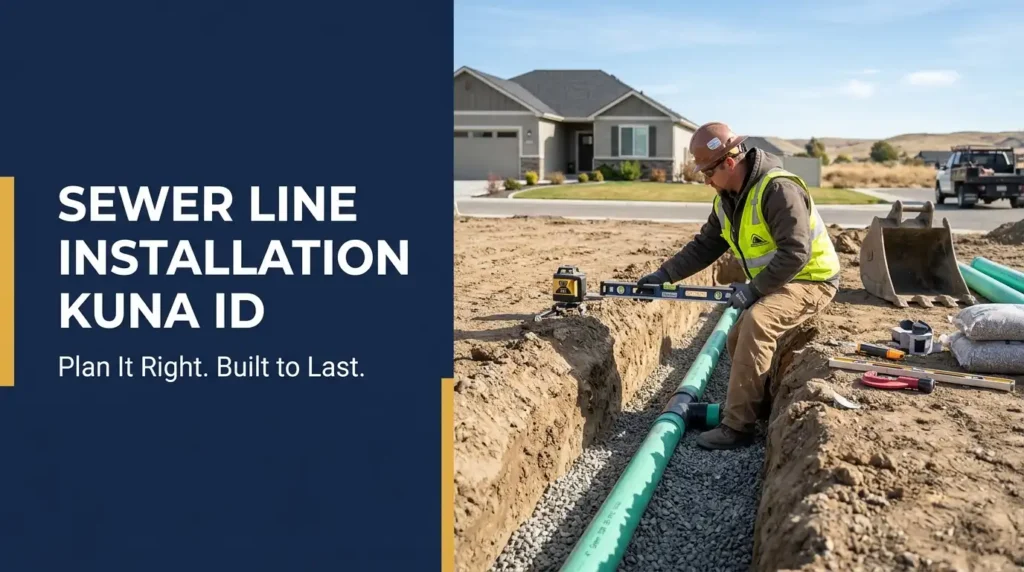
A failed sewer line rarely announces itself with one big event. It starts with a gurgling toilet, a slow shower drain, or a soggy patch in the yard that never dries out. If you are building, adding on, or finally leaving an aging septic system behind, sewer line installation in Kuna, ID is a project you want done right the first time. A poorly sloped or badly bedded line can cost you thousands in backups, torn-up landscaping, and repeat digs. This article walks you through Kuna’s soil, code requirements, methods, costs, and the decisions that protect your home for the next 50 to 100 years.
Key Takeaways
- Code sets the baseline: Residential sewer lines in the Treasure Valley use 4-inch pipe, a minimum 2% grade (¼ inch of fall per foot), and at least 12 inches of cover. We bury deeper where frost and traffic demand it.
- Kuna’s soil changes the price: Clay-heavy soil, caliche hardpan, and pockets of shallow basalt affect digging time, bedding needs, and whether trenchless methods are possible.
- Inspect before you install: A camera inspection and a call to 811 before digging prevent most surprises, including hidden utility lines, missing sewer stubs, and bellies in the existing pipe.
What a Sewer Line Does for Your Home
A sewer line carries all wastewater from your house to a municipal sewer main or a septic tank. Every toilet, tub, sink, and washing machine drains into it. The pipe runs underground, usually from a point about two feet outside your foundation to the connection at the street or the tank.
Gravity does all the work. That is why slope, bedding, and joint quality matter more than almost anything else. A line with too little fall lets solids settle. A line with a belly (a sagging low spot) holds standing waste and clogs again and again.
Our sewer line installation crews treat slope as the non-negotiable starting point on every job. Before you compare quotes, ask each contractor how they will confirm grade from the house to the connection point.
Why Kuna Properties Are Different
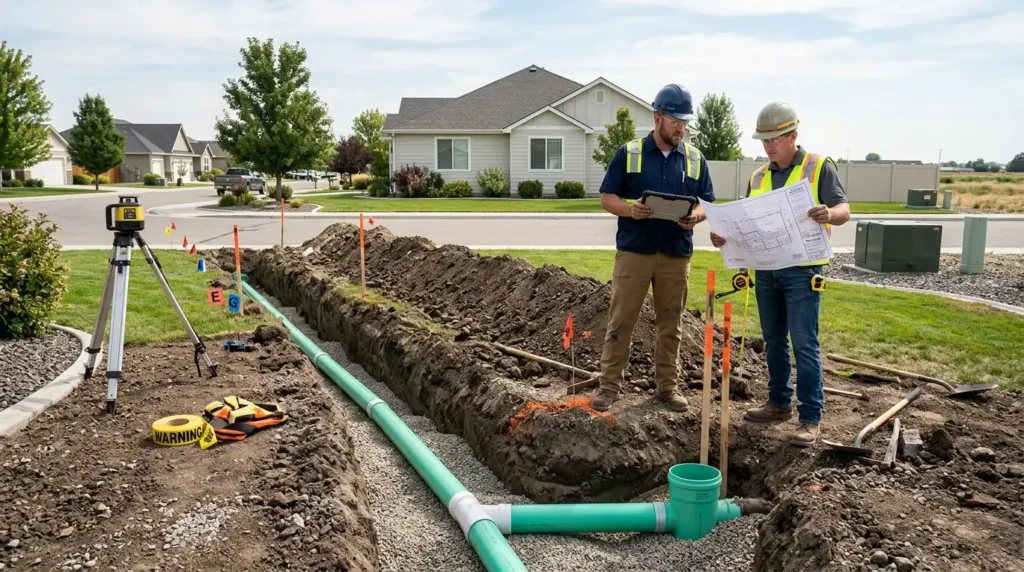
Kuna has one of the most mixed plumbing landscapes in the Treasure Valley. Much of the older residential area and many rural lots still run on septic systems. Newer subdivisions tie into the City of Kuna’s municipal sewer. That split shapes every project we quote.
On recent service calls in Kuna, we have worked on 1970s septic homes next door to 2022 builds on city sewer. The two need completely different plans. The newer home may need a simple lateral repair. The older home may need a full septic abandonment and a new tie-in.
Septic vs. Municipal Sewer in Kuna
| Factor | Septic System | Municipal Sewer Connection |
|---|---|---|
| Common in | Older Kuna neighborhoods, rural acreage | Newer subdivisions, city core |
| Regulating authority | Central District Health (Ada County) | City of Kuna / local plumbing permit authority |
| Ongoing cost | Pumping every 3-5 years, drain field risk | Monthly sewer utility bill |
| Typical failure point | Drain field in clay soil | Lateral joints, roots, bellies |
| Line length | Short run to tank (often 10-30 ft) | Longer run to street main (often 40-100+ ft) |
| Upgrade path | Convert to sewer when a main is available | Repair or replace the lateral |
Clay-heavy soils are hard on septic drain fields because they absorb effluent slowly. Larger families and added square footage push older, undersized systems past their limit. When a city main reaches your street, a conversion often costs less over time than a drain field replacement.
Call the City of Kuna to ask whether a sewer main runs near your property line before you budget for septic repairs.
How Kuna’s Soil Changes the Job
Soil type controls how fast we dig, what bedding we use, and how the pipe behaves over time. Kuna sits on the open plain southwest of Boise. The ground here is not uniform, even on the same block.
Our plumbers frequently see this: a crew hits soft silty clay for 20 feet, then runs into caliche (a cement-like layer of mineral-hardened soil) or basalt rock. That shift changes equipment needs mid-job. It is the main reason honest quotes in Kuna include a rock clause.
Kuna Soil Conditions and What They Mean
| Soil Condition | What Happens | How We Handle It |
|---|---|---|
| Clay-heavy soil | Expands when wet, shrinks when dry, shifts pipe over time | Granular bedding under and around the pipe, careful compaction |
| Caliche hardpan | Slows excavation, may need breaker equipment | Plan extra time and machine attachments |
| Shallow basalt | Can block trenchless paths, adds major labor | Rock excavation or rerouting the line |
| Sandy or silty loam | Easy digging but can cave in trenches | Trench shoring and proper backfill |
| High groundwater areas | Water fills the trench, hides markers | Pumps to dewater (never into the sewer line) |
Imported bedding is required in rocky soil. Native rock pressed against PVC creates point loads that crack pipe years later.
Ask your contractor what bedding material they plan to use and whether rock excavation is priced in or billed separately.
Also Check – Water Extraction Meridian ID: How to Stop Water Damage Before Mold Takes Hold
How Hard Water Affects Your Drain and Sewer Lines
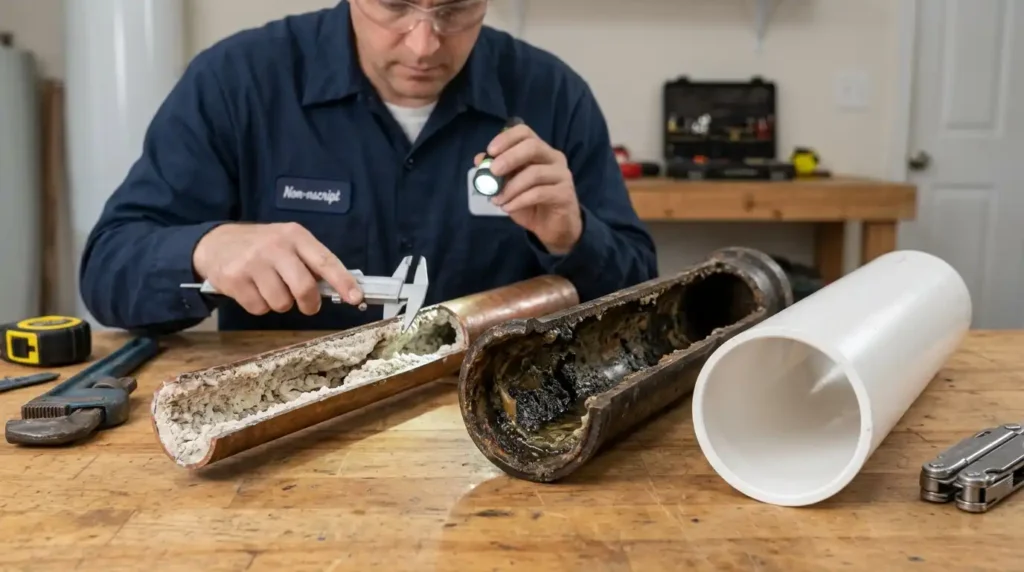
Hard water shortens the life of drain piping. Many Kuna homes rely on private wells carrying elevated iron, hardness minerals, and sometimes sulfur. Those minerals leave scale inside pipes and corrode older metal lines.
The biggest impact shows up in cast iron drain lines. Scale and corrosion roughen the pipe wall, which catches grease, paper, and debris. Over time, the effective pipe diameter shrinks.
| Pipe Type | Hard Water Effect | Long-Term Risk |
|---|---|---|
| Cast iron | Scale plus internal corrosion | Rough walls, recurring clogs, cracks |
| PVC | Minimal scale adhesion | Low risk with normal use |
| ABS | Minimal scale adhesion | Low risk, but sensitive to sun exposure before burial |
| Clay | Scale at joints | Root intrusion at weakened joints |
Water softeners help protect fixtures and water heaters. Route the softener discharge according to local code, especially on septic, so brine does not end up somewhere it causes problems.
If your home still has original cast iron drains, schedule a camera inspection before you connect a new exterior line to them.
Idaho Code Requirements for Sewer Line Installation
Code requirements set the minimum standard for every residential sewer line. A properly permitted job protects your home, your neighbors, and your resale value. Skipping permits can stall a home sale when an inspector or buyer finds unrecorded work.
The City of Boise Residential Sewer Installation Procedures brochure lays out the standards used across much of the Treasure Valley. Kuna permits come through the authority that covers your address, but the core technical rules line up closely.
Core Technical Standards
| Requirement | Standard | Why It Matters |
|---|---|---|
| Pipe size | 4-inch for residential service lines | Handles full household flow without clogging |
| Approved materials | PVC Schedule 40 or SDR 35, ABS Schedule 40, cast iron, others per code | Approved glue must match pipe type |
| Minimum grade | 2% (¼ inch of fall per foot) | Keeps solids moving with the water |
| Minimum cover | 12 inches unless approved otherwise | Protects from freezing and physical damage |
| Cleanouts | About 2 feet outside the building, at direction changes, max 100 feet apart | Gives access for future cleaning and cameras |
| 90° turns | Wye with 45° bend, or two 45° bends with a nipple | Prevents hard turns that trap waste |
| Testing | 5 PSI air test or water test to top of upper cleanout | Proves joints are watertight |
| Inspection | Before backfill, with 12-24 hours’ notice | Inspector must see the open trench |
Twelve inches is the legal floor, not our target. If you’ve spent a winter in Idaho, you know frost reaches well below a foot in cold snaps. We bury lines deeper wherever the slope and the connection elevation allow it.
Permit and Prep Steps
Sewer line installation in Kuna, ID follows a predictable sequence when you plan it correctly:
- Confirm your jurisdiction. Check whether your property falls under city sewer, a sewer district, or septic oversight by Central District Health.
- Pay connection fees. New tie-ins usually require assessment or capacity fees before connection.
- Pull the plumbing permit. A licensed plumbing or sewer contractor typically handles this for you.
- Request record drawings. These show the approximate location and depth of the sewer stub at your property.
- Call 811. Idaho requires notice at least two business days before digging so utilities get marked.
- Locate the stub. Crews dig carefully near the measured spot, looking for the old wood marker or tracer wire.
- Verify elevation. We shoot grade from the house exit to the stub to confirm a 2% slope is possible.
- Lay pipe downstream to upstream. Starting at the connection keeps grade accurate.
- Schedule inspection. The inspector checks bedding, slope, and the pressure test before any backfill.
Ask any contractor you interview to walk you through who pulls the permit and who schedules the inspection.
Warning Signs Your Sewer Line Is Failing
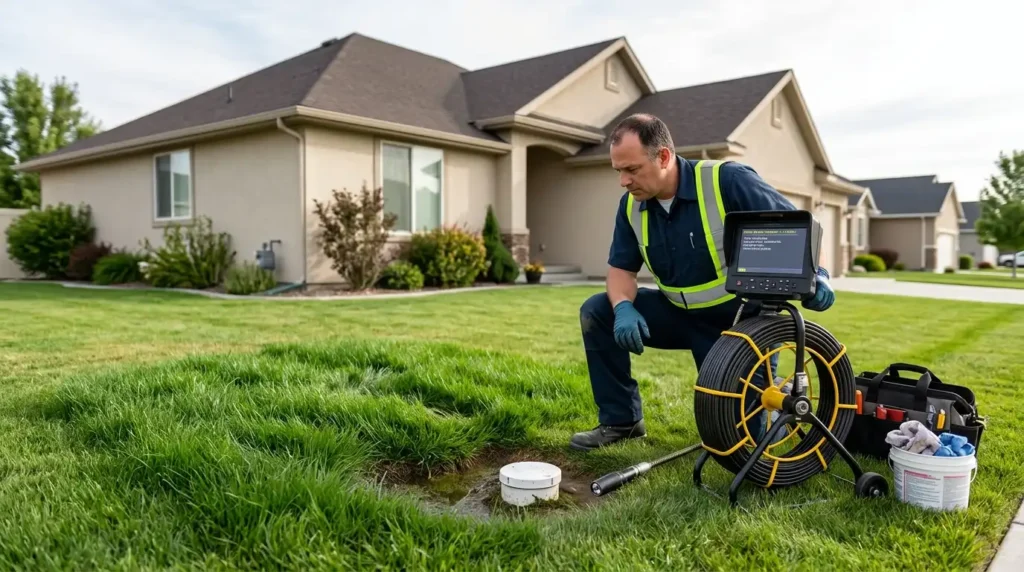
A failing sewer line shows symptoms in more than one fixture. One slow sink is usually a local clog. Several drains acting up together point to the main line.
Watch for these signs:
- Multiple slow drains in different rooms at the same time
- Gurgling toilets when the shower or washer drains
- Sewage backing up into a tub, shower, or floor drain
- Sewer odors in the yard or near the cleanout
- Wet, sunken, or extra-green patches along the sewer path, especially in dry weather
- Recurring clogs that come back weeks after clearing
- Trees growing near an older clay or cast iron line
If you’ve spent a summer in the Treasure Valley, you know lawns go brown fast in July heat. A bright green stripe across a dry yard is a red flag. That stripe is often fed by a leaking sewer line.
Steps to Troubleshoot Before You Call
- Test each fixture. Run water in sinks, tubs, and toilets one at a time to see which ones respond slowly.
- Check the lowest drain. Floor drains and basement showers back up first in a main line blockage.
- Open the cleanout cap carefully. Standing water inside the cleanout confirms a blockage downstream.
- Stop heavy water use. Pause laundry and dishwashers to prevent an overflow.
- Walk the sewer path. Look for soft ground, odors, or sinkholes.
- Book a camera inspection. Video shows roots, cracks, offsets, and bellies so the repair is based on evidence.
Wet yard spots do not always mean a sewer problem. A leaking water service line causes similar symptoms, and our leak detection team can tell the difference before anyone starts digging in the wrong place.
Installation Methods: Traditional Trench vs. Trenchless
Two main methods handle new and replacement sewer lines. Traditional trenching opens the ground along the full pipe path. Trenchless methods replace or rehabilitate the line through small access pits.
The right method depends on soil, pipe condition, access, and grade. On a brand-new build, trenching is the standard. On a replacement under a finished driveway or mature landscaping, trenchless often saves money on restoration.
Method Comparison
| Factor | Traditional Trench | Pipe Bursting (Trenchless) | Pipe Lining / CIPP (Trenchless) |
|---|---|---|---|
| How it works | Dig full trench, lay new pipe | Pull new pipe through the old one, breaking it outward | Cure a resin liner inside the existing pipe |
| Best for | New construction, septic conversions, fixing bad grade | Replacing damaged lines with good alignment | Cracked lines that still hold their shape |
| Fixes bellies? | Yes | Limited | No |
| Yard disruption | High | Low | Very low |
| Typical time | 1-5 days | 1-2 days | 1-2 days |
| Rock or basalt | Slower but workable | Can block the path | Not affected if pipe is intact |
| Restoration cost | Higher (lawn, concrete, landscaping) | Lower | Lowest |
Pros and Cons at a Glance
Traditional trench pros:
- Corrects slope problems and bellies completely
- Lets inspectors see every joint and the bedding
- Works in nearly any soil
Traditional trench cons:
- Tears up lawns, sprinklers, and concrete
- Longer timeline in rocky ground
Trenchless pros:
- Saves driveways and landscaping
- Faster completion on qualifying lines
Trenchless cons:
- Cannot fix a line with poor grade
- Not possible with collapsed sections or certain layouts
- Requires hydro jetting prep for lining
Sewer line installation in Kuna, ID on new construction almost always uses an open trench. Request a camera inspection first if you are replacing an existing line and hoping to go trenchless.
How We Install a New Sewer Line
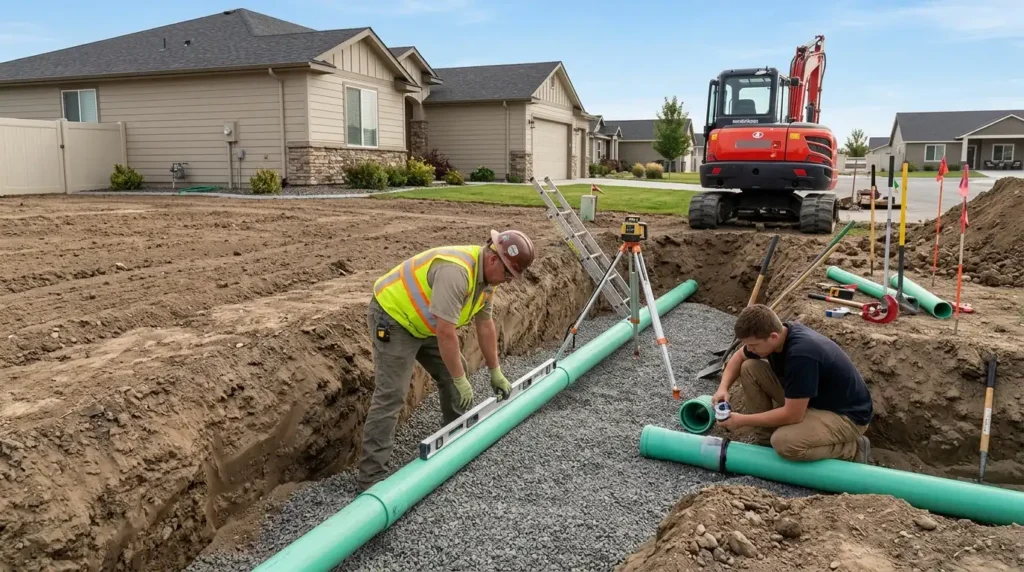
A professional installation follows a fixed sequence. Each step protects the one after it.
- Inspect the existing system. We run a camera through any current line and confirm where it connects.
- Mark utilities. The 811 locate shows gas, power, fiber, and water lines.
- Set the grade plan. We measure the house exit elevation and the connection elevation.
- Excavate the trench. Width and depth match the pipe, soil, and safety needs.
- Place bedding. Granular material goes under the pipe for even support.
- Lay and join pipe. We use 4-inch PVC with matching primer and cement, checking grade at every joint.
- Install cleanouts. One near the foundation and at required direction changes.
- Pressure test. A 5 PSI air test or water test proves the joints hold.
- Pass inspection. The inspector signs off before any soil goes back in.
- Backfill and compact. We bed around the pipe first, then backfill in layers to prevent settling.
- Restore the site. Sod, gravel, and sprinkler lines get put back.
Request a written scope that lists each of these steps before you sign any contract.
Sewer Line Installation Costs in Kuna
Sewer line costs in Kuna depend on length, depth, soil, method, and permit fees. A short tie-in on soft soil costs far less than a 120-foot run through caliche. Honest pricing starts with an on-site evaluation.
The ranges below reflect typical 2026 Treasure Valley pricing. Your quote will vary based on site conditions.
Typical Project Cost Ranges
| Project Type | Typical Cost Range | Main Cost Drivers |
|---|---|---|
| Camera inspection | $49-$350 | Access, line length |
| Spot repair | $500-$1,500 | Depth, single damaged section |
| Trenchless repair or lining | $2,000-$6,000 | Pipe length, prep work |
| Partial excavation or replacement | $3,000-$10,000 | Length, soil, restoration |
| New full line (open trench) | $5,000-$15,000+ | Run length, depth, rock |
| Septic-to-sewer conversion | $8,000-$25,000+ | Connection fees, tank abandonment, distance to main |
Per-Foot Pricing Comparison
| Method | Approximate Cost per Foot | Notes |
|---|---|---|
| Traditional trench | $50-$250 | Lower in soft soil, higher in rock |
| Pipe bursting | $60-$250 | Requires access pits at each end |
| Pipe lining (CIPP) | $80-$250 | Requires intact pipe shape |
Hidden Costs to Plan For
- Permit and inspection fees set by your jurisdiction
- Connection or capacity fees for new city tie-ins
- Rock excavation in caliche or basalt
- Concrete cutting and replacement under driveways or sidewalks
- Sprinkler and landscape repair after backfill
- Septic tank abandonment, which requires pumping and filling with sand or gravel
At Meridian Plumbing Services, we put these line items in writing so the final bill matches the quote. When you compare bids for sewer line installation in Kuna, ID, check that each one includes permits, restoration, and a rock clause.
Pipe Material Lifespan Comparison
Pipe material determines how long your sewer line lasts. Modern PVC dominates new residential installs for good reason. Older Kuna homes may still have cast iron, clay, or even asbestos cement lines from earlier eras.
| Material | Expected Lifespan | Strengths | Weaknesses |
|---|---|---|---|
| PVC (Schedule 40 / SDR 35) | 100+ years | Smooth walls, root-resistant joints, light weight | Can crack from point loads on rocky bedding |
| ABS | 50-80 years | Easy to install, tough in cold | Can warp with sun exposure before burial |
| Cast iron | 50-75 years | Strong, quiet | Corrodes, scales badly with hard water |
| Vitrified clay | 50-60 years | Resists chemicals | Brittle, roots enter at joints |
| Concrete | 50-100 years | Strong for large diameters | Heavy, can erode inside |
| Asbestos cement | 50-70 years | Durable when undisturbed | No longer installed, needs careful handling |
| Orangeburg (fiber) | 30-50 years | None today | Obsolete, collapses and deforms |
Sewer lines can last anywhere from 50 to 100 years or more, depending on material and wear. A PVC line installed today with proper bedding should outlast the mortgage.
Ask your plumber to identify your current pipe material on camera before deciding between repair and replacement.
Repair vs. Replace: Making the Right Call
Not every sewer problem needs a full replacement. A single crack, one root-damaged joint, or one collapsed section can often be repaired in place. Widespread failure calls for a new line.
| Situation | Repair | Replace |
|---|---|---|
| One cracked or broken joint | ✔ | |
| Single root intrusion point | ✔ | |
| One collapsed short section | ✔ | |
| Roots at multiple joints, returning yearly | ✔ | |
| Multiple cracks along the run | ✔ | |
| Bellies or poor slope | ✔ (trench) | |
| Orangeburg or failing clay pipe | ✔ | |
| Line over 50 years old with repeat failures | ✔ | |
| Converting from septic to city sewer | ✔ (new line) |
One way to frame the decision: if you have paid for two or more repairs on the same line in five years, replacement usually costs less over the next decade. Repeated spot fixes on a failing line are money spent twice.
Bring your camera footage to your estimate meeting and ask the contractor to point to each defect on screen.
Converting from Septic to City Sewer in Kuna
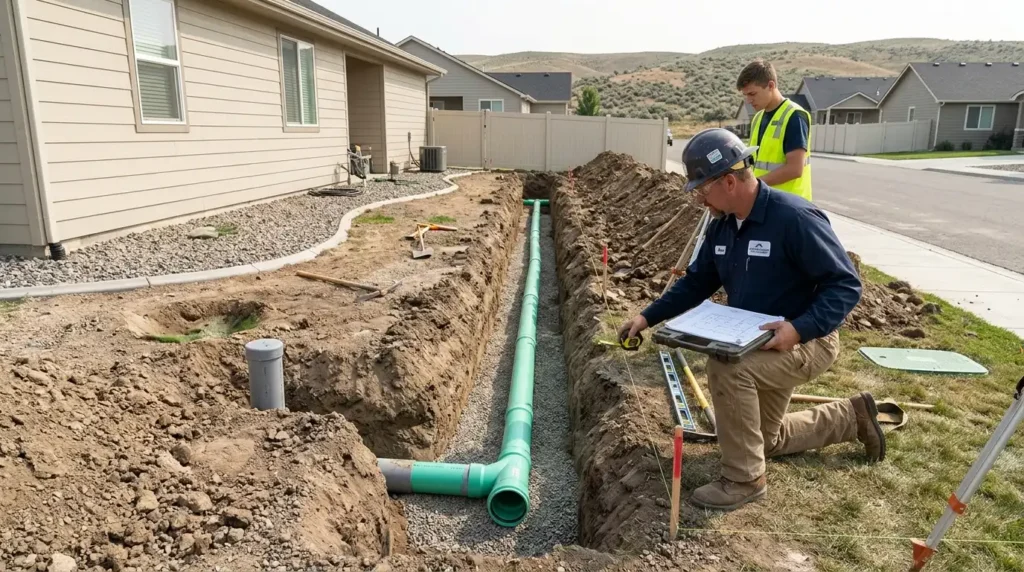
A septic-to-sewer conversion replaces your tank and drain field with a direct line to the municipal main. As Kuna grows, more streets gain sewer access. Conversion ends pumping bills and drain field worries.
- Confirm sewer availability. Ask the city whether a main and stub serve your lot.
- Get connection fees in writing. These cover your share of the sewer system and treatment capacity.
- Pull permits. You need a plumbing permit and may need approval to abandon the septic system.
- Install the new line. We run 4-inch pipe from the house to the stub at proper grade.
- Abandon the septic tank. The tank gets pumped and filled with sand or gravel, and access pipes are filled or removed.
- Pass final inspection. The inspector confirms the new connection and the tank abandonment.
On recent service calls in Kuna, conversions have gone smoothest when homeowners scheduled them in late spring or early fall. The ground is workable and crews avoid frozen soil and peak summer heat.
Start by requesting your property’s sewer record drawings from the city.
Sewer Line Maintenance Checklist
A new sewer line still needs basic care. Good habits keep it flowing for decades.
Monthly:
- Keep grease, wipes, and paper towels out of drains
- Use drain strainers in showers and kitchen sinks
- Watch for slow drains or gurgling
Yearly:
- Check that cleanout caps are secure and accessible
- Walk the sewer path for wet spots or settling
- Trim or remove trees and shrubs planted near the line
Every 2-3 years (or after symptoms):
- Schedule a camera inspection for older lines
- Book hydro jetting if grease or scale buildup shows up on camera
- Pump septic tanks every 3-5 years if you are not yet on city sewer
Lower water use also reduces strain on septic systems and drain lines. The EPA WaterSense program lists labeled toilets, showerheads, and home maintenance tips that cut household water use without sacrificing performance.
Put a recurring reminder on your calendar for a yearly sewer path walk-through each spring.
Seasonal Timing for Sewer Work in the Treasure Valley
Timing affects cost and speed. Frozen ground slows excavation in winter. Summer heat stresses crews and dries out clay, which makes compaction harder to get right.
| Season | Conditions | Best For |
|---|---|---|
| Spring | Workable soil, possible high groundwater | Planned replacements, conversions |
| Summer | Dry, hard clay, temperatures near 100°F | Trenchless work, quick repairs |
| Fall | Mild temps, stable soil | Ideal for full installations |
| Winter | Frozen top layer, short days | Emergency repairs only |
Emergencies do not wait for good weather. Plan scheduled sewer line installation in Kuna, ID for fall or spring, and keep a reliable contractor’s number handy for the rest of the year.
Faqs:
1. How long does sewer line installation take?
Most residential jobs take 1 to 5 days. Length, depth, rock, and inspection scheduling drive the timeline.
2. Do I need a permit to replace my sewer line?
Yes. Permits are required before work begins, and inspections are required before the trench is covered.
3. What size pipe is used for a home sewer line?
Residential service lines use 4-inch pipe, most often PVC or ABS.
4. How deep is a sewer line buried?
Code requires at least 12 inches of cover. We often go deeper for frost protection when grade allows.
5. Can I install my own sewer line?
Some jurisdictions allow property owners to do their own work on single-family homes and duplexes. A licensed contractor is strongly recommended unless you have real sewer installation experience.
6. Is trenchless always cheaper?
No. Trenchless saves on restoration, but it cannot fix poor slope or collapsed pipe. Open trench is often cheaper on bare lots.
7. How do I know if roots are in my line?
Recurring clogs and gurgling drains near trees are strong clues. A camera inspection confirms it.
8. What happens to my septic tank after I connect to city sewer?
The tank is pumped, then filled with sand or gravel. Access pipes are filled or removed.
9. How much does sewer line installation in Kuna, ID cost?
Most full installations range from about $5,000 to $15,000, with septic conversions running higher. An on-site evaluation gives you a firm number.
Plan Your Kuna Sewer Line the Right Way
A sewer line is a 50-to-100-year decision. Correct slope, proper bedding, approved materials, and a passed inspection separate a line that lasts from one that fails in a decade. Kuna’s clay, caliche, and mix of septic and city sewer make local experience matter even more.
Our crews bring transparent pricing, written scopes, and plain-language explanations to every job across Kuna, Meridian, Boise, and Nampa. For planned sewer line installation in Kuna, ID, schedule a camera inspection and on-site estimate first.
If sewage is backing up right now, do not wait for business hours. Call our emergency plumber team, available 7 days a week, to stop the damage and diagnose the line today.