How Water Line Repair Meridian ID Protects Your Home and Keeps Your Water Bill in Check
A broken water line rarely announces itself. It hides three feet underground, leaking hundreds of gallons while your water bill climbs and your yard turns soft. Fast, accurate Water Line Repair Meridian ID is what separates a one-day fix from a foundation problem. At Meridian Plumbing Services, we see the same pattern every year. Homeowners notice one small sign, wait a few months, and then face a much bigger repair.
This article covers the warning signs, the local causes, real cost ranges, and how to decide between repair and replacement. You’ll also get a maintenance checklist you can use this weekend.
Key Takeaways
- Low water pressure, a spiking water bill, or a soggy patch in the yard are the top three signs of a failing service line. Act within days, not months.
- Isolated damage on a newer pipe usually means a spot repair. Old galvanized or polybutylene lines with repeated leaks almost always justify full replacement.
- Pinpoint detection before digging saves money. Accurate location keeps excavation small and your landscaping intact.
What a Water Service Line Is (and Who Owns It)
Your water service line carries clean water from the city meter to your home’s main shutoff. In most Meridian neighborhoods, the city maintains the main and meter. The pipe from the meter to your house is typically the homeowner’s responsibility.
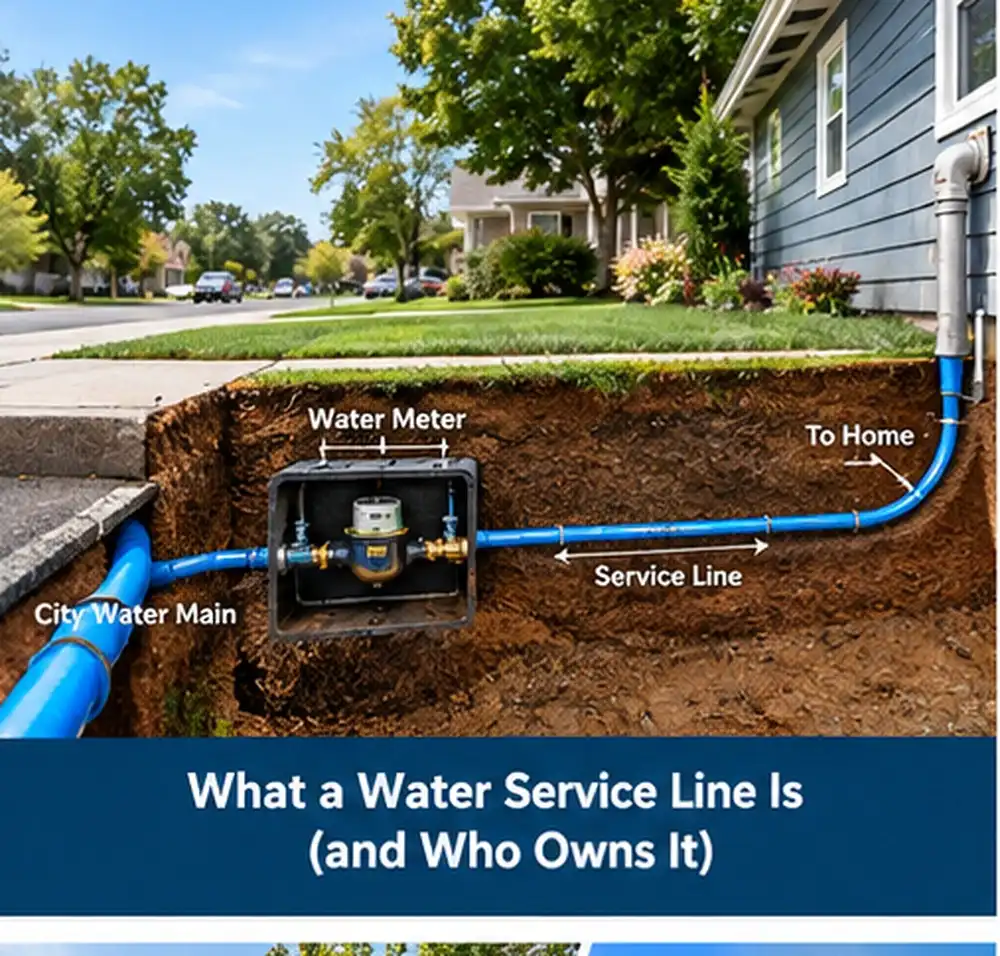
That means repair costs on your side of the meter usually fall on you. Knowing this up front helps you budget and act quickly.
| Section of Line | Typical Owner | Who to Call |
|---|---|---|
| City water main (under street) | City of Meridian | City Public Works |
| Water meter and meter box | City of Meridian | City Public Works |
| Meter to house (service line) | Homeowner | Licensed plumber |
| Main shutoff and interior piping | Homeowner | Licensed plumber |
| Pressurized irrigation (non-potable) | Irrigation district up to first valve, then homeowner | Irrigation district or sprinkler pro |
Quick tip: Meridian has two separate water systems at many homes. A wet spot near your sprinklers may be an irrigation leak, not your drinking water line. We help you sort out which is which before anyone digs.
Check Also: How Repiping Nampa ID Homes Stops Leaks, Restores Water Pressure, and Protects Your Budget
Warning Signs You Need Water Line Repair Meridian ID
On recent service calls in Meridian, most homeowners called us after noticing two or more symptoms at once. One sign alone can be a fluke. Several signs together point strongly to a service line leak.
Common Symptoms
- Sudden drop in water pressure at every fixture, not just one
- Unexplained jump in your water bill with no change in habits
- Wet, soggy, or unusually green patches in the lawn between the street and house
- Hissing or running water sounds when every fixture is off
- Discolored, cloudy, or rusty water from the tap
- Air sputtering from faucets
- Water meter spinning with all water turned off
- Cracks or dampness near the foundation or in the crawl space
- Sinkholes or sunken soil along the line’s path
Warning Signs Severity Table
| Symptom | Severity | What It Usually Means | Recommended Action |
|---|---|---|---|
| Slightly higher bill | Low to Moderate | Small leak or running toilet | Run a meter test this week |
| Low pressure at all fixtures | Moderate | Leak, corrosion, or buildup in the line | Schedule an inspection |
| Green or soggy yard patch | High | Active underground leak | Call within 24 to 48 hours |
| Meter moves with water off | High | Confirmed leak somewhere on your side | Book professional leak detection |
| Discolored or bad-tasting water | High | Possible contamination or corroded pipe | Stop drinking it; call now |
| No water at all / flooding yard | Emergency | Burst or separated line | Shut off at meter; call immediately |
| Sinkhole near line | Emergency | Major leak eroding soil | Keep people off; call immediately |
The 10-Minute Meter Test
Before you call anyone, this simple test confirms whether you have a leak at all. It’s the same first step our technicians use.
- Turn off every faucet, appliance, and irrigation zone.
- Make sure no toilets are refilling.
- Find your water meter (usually in a box near the curb).
- Note the leak indicator (small triangle or dial) and the current reading.
- Wait 30 to 60 minutes without using water.
- Check again. Any movement means water is escaping.
- Close your main shutoff at the house and recheck. If the meter still moves, the leak is likely between the meter and your house.
If step 7 shows movement, you’re almost certainly dealing with a service line leak. That’s when our leak detection team pinpoints the exact spot so we dig once, in the right place.
Why Water Lines Fail in Meridian Specifically

Meridian has its own set of pipe-killers. Our crews deal with local soil, hard water, and Idaho winters on nearly every job. Understanding the cause helps you choose the right fix and avoid a repeat failure.
Freeze-Thaw Cycles
If you’ve spent a winter in Idaho, protecting your pipes makes complete sense. Repeated freezing and thawing shifts the ground around your line. Lines installed too shallow, or near driveways where frost drives deeper, take the most stress. Damage often forms in January but doesn’t show up until the spring thaw.
Clay and Loam Soil Movement
Meridian sits on clay and loam soils that swell when wet and shrink when dry. That constant movement puts stress on joints and fittings. Over years, it can crack pipe walls or pull couplings apart. Heavy summer irrigation next to a dry winter makes the swing even worse.
Hard Water Mineral Buildup
Treasure Valley water carries elevated calcium and magnesium. In metal pipes, that scale narrows the inside diameter and traps moisture against the pipe wall. The result is lower pressure, accelerated corrosion, and eventually pinhole leaks.
Tree Root Intrusion
Roots hunt for moisture. A tiny weep at a joint attracts them like a magnet. Once inside, roots widen cracks and can crush older, thinner pipe. Our plumbers frequently see this in older Boise homes and Meridian’s established neighborhoods with mature maples, willows, and cottonwoods.
Aging Pipe Materials
Meridian’s rapid growth means homes range from brand-new builds to houses with 50-year-old service lines. Older homes may still have galvanized steel, which rusts from the inside out. Homes built from roughly 1978 to 1995 may have polybutylene, a gray plastic known for sudden failure.
Other Common Causes
- High water pressure above 80 psi strains joints (a pressure-reducing valve fixes this)
- Poor original installation or bad backfill with rocks against the pipe
- Landscaping and fence-post damage
- Construction traffic and heavy equipment over the line
| Cause | How Common in Meridian | Typical Damage | Best Prevention |
|---|---|---|---|
| Freeze-thaw cycles | Very common | Cracks, separated joints | Proper burial depth, insulation at exposed points |
| Clay soil shifting | Very common | Joint stress, misalignment | Flexible pipe materials, consistent irrigation |
| Hard water scale | Common in metal pipes | Corrosion, low pressure | Water softener, upgrade to PEX or HDPE |
| Tree roots | Common in older areas | Cracks, crushed pipe | Plant trees 10+ feet from line |
| Aging galvanized pipe | Common in older homes | Rust, pinholes, low flow | Full replacement |
| Polybutylene failure | Occasional | Sudden splits | Proactive replacement |
| High pressure | Common | Fitting failures | Install or service a PRV |
Pipe Material Lifespan: What’s Under Your Yard?
The pipe material is one of the biggest factors in the repair vs. replace decision. A leak in a 20-year-old HDPE line is a different story than a leak in a 60-year-old galvanized line.
| Material | Typical Lifespan | Common Era Installed | Strengths | Weaknesses |
|---|---|---|---|---|
| Galvanized steel | 40 to 60 years | Pre-1970s | Durable when new | Rusts internally, scale buildup |
| Copper (Type K) | 50 to 70+ years | 1950s to present | Long-lasting, reliable | Pinholes with aggressive water, costly |
| Polybutylene | 10 to 25 years | ~1978 to 1995 | Inexpensive at the time | Prone to sudden failure |
| PVC | 25 to 40+ years | 1970s to present | Low cost, corrosion-free | Brittle in cold, joint stress in shifting soil |
| PEX | 40 to 50+ years | 1990s to present | Flexible, freeze-resistant | Must be protected from UV |
| HDPE (polyethylene) | 50+ years | 1990s to present | Flexible, fused joints, ideal for trenchless | Requires specialized fusion equipment |
| Lead | Past service life | Pre-1950s | None today | Health hazard; replace immediately |
Our take: For new service lines in Meridian, we usually recommend HDPE or Type K copper. Both handle soil movement and freeze cycles well. HDPE also pairs perfectly with trenchless installation.
Check Also: Water Line Repair Kuna ID: How to Spot, Fix, and Prevent Costly Main Line Leaks
Repair or Replace? How We Help You Decide
At Meridian Plumbing Services, we give you honest options, not upsells. Sometimes a $900 spot repair is the smart call. Other times, patching an old line just means paying twice. Here’s how we weigh it during water line repair in Meridian ID jobs.

Signs a Repair Makes Sense
- One isolated leak in a single spot
- No history of previous failures
- Pipe is newer (copper, PEX, or HDPE in good shape)
- Small crack or one failed fitting
- Minor pressure drop
Signs Replacement Is Smarter
- Multiple leaks along the same line
- Galvanized, polybutylene, or lead pipe
- Roots invading the line in several places
- Recurring discolored water
- Persistent low pressure even after repairs
- Line is near or past its expected lifespan
Repair vs. Replace Comparison
| Factor | Spot Repair | Full Replacement |
|---|---|---|
| Best for | Isolated damage on sound pipe | Old, corroded, or repeatedly failing pipe |
| Typical cost range* | $600 to $2,500 | $2,500 to $8,000+ |
| Time to complete | A few hours to 1 day | 1 to 3 days |
| Yard disruption | Small, localized hole | Trench or two small access pits (trenchless) |
| Permit needed | Sometimes | Almost always |
| Expected result | Fixes current leak only | New line, often 50+ years of service |
| Risk of repeat leak | Moderate to high on old pipe | Very low |
*Ranges reflect typical Treasure Valley jobs. Your quote depends on line length, depth, access, material, and permits. We always provide upfront pricing before work begins.
A rule of thumb we share with clients: If a single repair costs more than 40 to 50 percent of a full replacement, and the pipe is older than 40 years, replacement usually wins on long-term value.
Trenchless vs. Traditional Excavation
Once we know what needs fixing, the next question is how we reach the pipe. We offer both trenchless and traditional excavation methods.
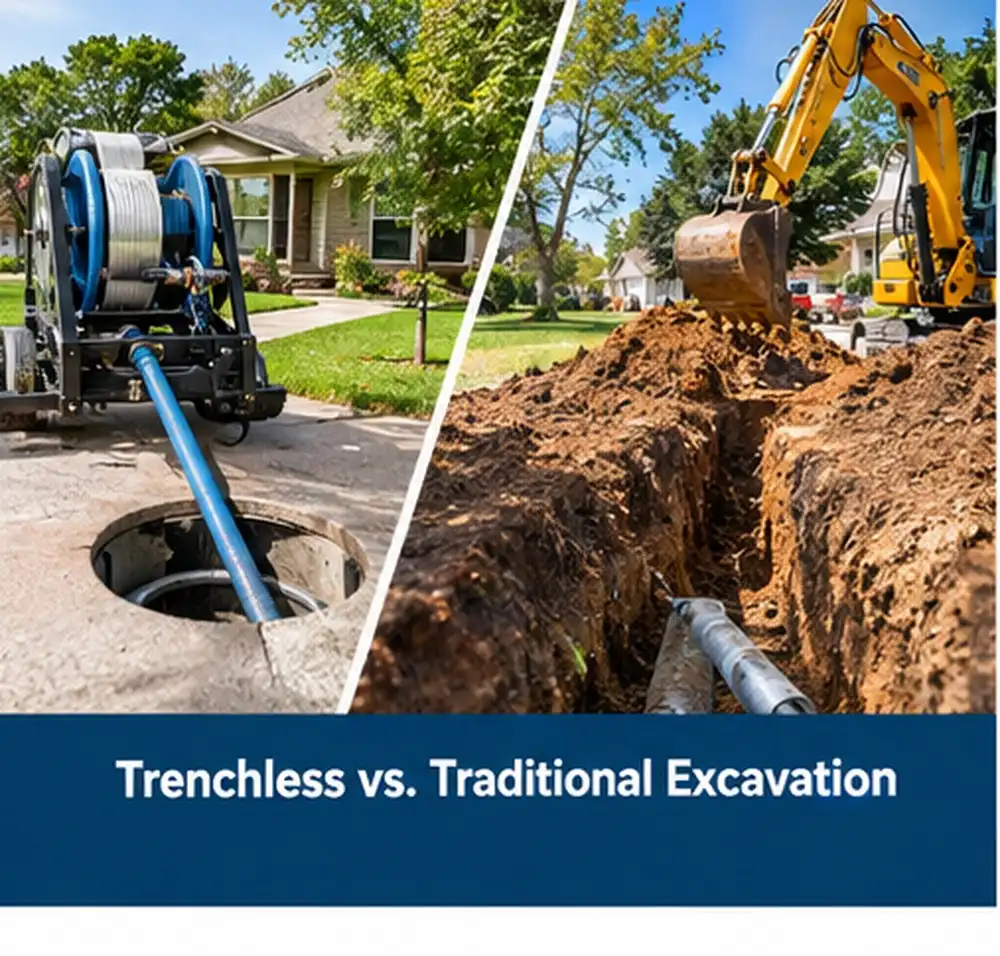
The right choice depends on soil, pipe route, obstacles, and what’s on top.
Method Comparison Table
| Feature | Trenchless (Pipe Bursting / Directional Boring) | Traditional Excavation |
|---|---|---|
| Digging required | Two small access pits | Full trench along line |
| Lawn and landscape impact | Minimal | Significant |
| Driveways, sidewalks, trees | Usually preserved | May require removal and restoration |
| Typical timeline | Often 1 day | 1 to 3 days |
| Upfront cost | Often similar or higher per foot | Sometimes lower for short, open runs |
| Restoration cost | Very low | Can add hundreds to thousands |
| Best for | Lines under hardscape, mature landscaping | Short runs, spot repairs, complex fittings |
| New pipe material | Typically HDPE | Any approved material |
Trenchless: Pros and Cons
Pros
- Saves your lawn, driveway, and landscaping
- Faster in most cases
- Lower restoration costs after the job
- Seamless HDPE pipe resists roots and soil movement
Cons
- Not ideal for every soil condition or route
- Requires specialized equipment
- Not always cheaper for very short, open runs
Traditional Excavation: Pros and Cons
Pros
- Direct access to inspect the full pipe
- Best for spot repairs and fitting failures
- Works in nearly any situation
Cons
- Heavy yard disruption
- Higher restoration costs for sod, concrete, or pavers
- Longer timeline in many cases
On recent service calls in Meridian, roughly half of full replacements were good trenchless candidates. The other half had tight routes, rocky backfill, or utility crossings that made excavation the safer choice. We’ll walk you through which fits your property.
Check Also: How Water Heater Repair Middleton Protects Your Idaho Home from Hard Water Damage and Higher Energy Bills
What Water Line Repair Meridian ID Costs
Pricing is the first question most homeowners ask. We believe in transparent pricing, so here’s what actually drives the number on your quote.
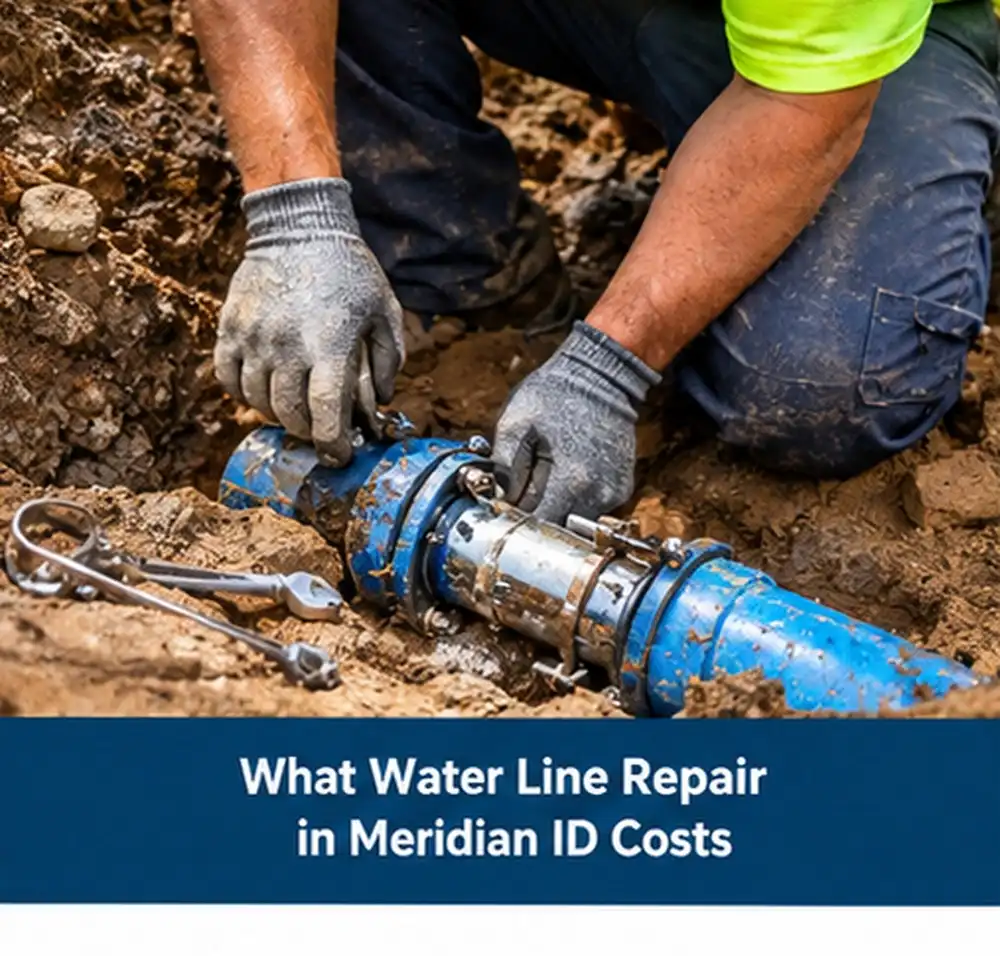
Main Cost Factors
- Length of pipe needing work
- Burial depth (Treasure Valley service lines are typically buried around 3 feet deep, below the frost line)
- Repair vs. full replacement
- Trenchless vs. excavation
- Surface restoration (concrete, pavers, sod)
- Permit and inspection fees
- Emergency or after-hours timing
Typical Cost Breakdown
| Service | Typical Cost Range* | Notes |
|---|---|---|
| Professional leak detection | $150 to $500 | Often saves far more in avoided digging |
| Spot repair (single leak) | $600 to $2,500 | Depends on depth and access |
| Fitting or joint repair | $400 to $1,500 | Common at meter or house connection |
| Full replacement, excavation | $2,500 to $7,000+ | Plus restoration costs |
| Full replacement, trenchless | $3,000 to $8,000+ | Lower restoration costs |
| Per-foot replacement (general) | $60 to $250 per foot | Varies with method and material |
| Pressure-reducing valve install | $300 to $900 | Protects new line from high pressure |
| Concrete or driveway restoration | $500 to $3,000+ | Avoided with trenchless in many cases |
| Plumbing permit | Varies by jurisdiction | Included in our quotes |
*These are general Treasure Valley ranges, not a quote. We inspect first and give you a written price before any work starts.
What a Leak Costs You If You Wait
A hidden leak isn’t just a repair bill. It’s wasted water, higher utility costs, and soil erosion under your home. According to the EPA WaterSense program, household leaks waste more than 1 trillion gallons of water nationwide every year. A steady underground leak can easily push a household’s waste far beyond a dripping faucet.
| Leak Size | Approx. Water Lost per Day | Approx. Water Lost per Month | Risk Level |
|---|---|---|---|
| Slow seep | 50 to 100 gallons | 1,500 to 3,000 gallons | Bill creep, soil softening |
| Steady leak | 200 to 500 gallons | 6,000 to 15,000 gallons | Erosion, foundation risk |
| Major break | 1,000+ gallons | 30,000+ gallons | Flooding, sinkholes, emergency |
Estimates for illustration; actual loss depends on pipe size and pressure.
How Our Water Line Repair Process Works
We keep the process simple, clear, and jargon-free. Here’s what happens from your first call to final cleanup on a typical water line repair Meridian ID homeowners book with us.
- Initial call and triage. We ask about symptoms, water service status, and whether the leak is active. Emergencies get priority scheduling.
- On-site inspection. Our technician checks the meter, shutoff, pressure, and visible signs in the yard and crawl space.
- Pinpoint leak location. We use acoustic listening equipment, pressure testing, and line tracing to find the exact failure point.
- Clear options and upfront pricing. You get repair and replacement options with honest pros, cons, and a written price.
- Utility locates and permits. We call 811 (Digline) to mark buried utilities and pull any required permits.
- Repair or replacement. We fix the damaged section or install a new line using durable, code-approved materials.
- Pressure test. We test the line before backfilling to confirm a leak-free connection.
- Inspection (if required). A plumbing inspector signs off on permitted work.
- Backfill, restore, and clean up. We compact the soil properly, restore the surface, and leave your property clean.
- Flush and verify. We flush the lines, check pressure at fixtures, and recheck the meter.
What to expect: Your water will be shut off temporarily during the work. Most spot repairs restore service the same day.
Idaho Permits, Codes, and Digging Rules
Permits protect you. They make sure the work meets Idaho plumbing code and gets inspected before it’s buried for decades.
| Requirement | What It Means for You |
|---|---|
| Plumbing permit | Most service line replacements require a permit through the local jurisdiction or the Idaho Division of Occupational and Professional Licenses. |
| Licensed plumber | Idaho requires licensed plumbers for water service work. Always verify licensing. |
| Inspection | Permitted work is inspected before backfill in most cases. |
| Call 811 (Digline) | Idaho law requires notice at least two business days before digging. It’s free. |
| Irrigation district notice | If digging near pressurized irrigation lines, contact the irrigation district ahead of time. |
| Pressure limits | Code generally requires a pressure-reducing valve when static pressure exceeds 80 psi. |
When you hire us for water line repair Meridian ID, we handle the permit, the 811 call, and the inspection scheduling. You don’t have to chase paperwork.
Seasonal Timing: When Water Lines Fail in the Treasure Valley

Idaho’s seasons change how lines fail and how quickly we can fix them. Planning around the calendar can save money and reduce stress.
| Season | What Happens to Water Lines | What to Watch For | Repair Conditions |
|---|---|---|---|
| Winter (Dec to Feb) | Freezing, ground heave, burst pipes | No water, pressure loss, meter box ice | Frozen ground slows excavation |
| Spring (Mar to May) | Thaw reveals winter cracks; roots wake up | Soggy patches, bill spikes | Good; soil workable |
| Summer (Jun to Aug) | Heavy irrigation, clay soil shrinks and swells | Low pressure at peak times, green strips | Best for excavation |
| Fall (Sep to Nov) | Ground cools; last chance before freeze | Small leaks worth fixing now | Very good; plan before frost |
Our advice: Spring thaw is when hidden winter damage shows up. Summer offers the easiest digging. Fall is your window to fix small leaks before freezing temperatures turn them into emergencies.
Here’s a related point many homeowners miss. A failing water line sometimes shows up alongside slow or backing-up drains, which usually point to the sewer side instead. If your fixtures drain slowly too, our drain cleaning crew can clear and camera-inspect your sewer line on the same visit.
Water Quality and Contamination Risks
A broken line isn’t only a leak problem. It can become a health problem. When pressure drops, soil, debris, and groundwater can be drawn into a cracked pipe.
Contamination Warning Signs
- Brown, yellow, or rusty water
- Cloudy water that doesn’t clear after running
- Earthy, metallic, or sewage-like smell
- Sediment or grit in faucet aerators
- Sudden taste change
What to Do
- Stop drinking the water until the cause is found.
- Use bottled water for drinking and cooking.
- Call us to inspect the line.
- After repair, flush all faucets for several minutes.
- Clean faucet aerators and replace fridge and filter cartridges.
Some homes on the edges of Meridian and rural Ada and Canyon counties still use private wells. If that’s you, the line repair is only part of the job. The CDC’s well water testing guidelines recommend testing after any repair to your well system and whenever you notice a change in color, taste, or smell. Use a state-certified lab for accurate results.
Preventative Maintenance Checklist
Most service line failures give warning. A little routine attention catches problems while they’re still small and cheap. Here’s the checklist our plumbers use in their own homes.
Monthly
- Compare your water bill to the same month last year
- Glance at the yard between the meter and house for wet or green strips
- Listen for running water when nothing is on
Every 6 Months
- Run the 10-minute meter test
- Check water pressure with a hose-bib gauge (aim for 40 to 80 psi)
- Exercise your main shutoff valve so it works in an emergency
- Inspect the meter box for standing water
Before Winter (September to October)
- Disconnect garden hoses
- Insulate exposed pipes in crawl spaces and near the meter
- Blow out irrigation lines
- Seal crawl space vents and gaps
- Know where your shutoff is and keep it accessible
Every Spring
- Look for soggy areas as the ground thaws
- Check pressure again after winter
- Watch the first few water bills for spikes
Long-Term
- Install a water softener to reduce scale in metal pipes
- Install or service a pressure-reducing valve
- Plant trees at least 10 feet from the service line
- Replace galvanized or polybutylene lines proactively
- Schedule a professional plumbing inspection every few years, especially in older homes
Prevention vs. Repair Cost Snapshot
| Preventative Step | Typical Cost | Problem It Helps Prevent | Potential Repair Avoided |
|---|---|---|---|
| Hose-bib pressure gauge | Under $20 | High-pressure joint failure | $600 to $2,500 |
| PRV install or service | $300 to $900 | Fitting and line stress | $600 to $8,000+ |
| Pipe insulation | $20 to $150 | Frozen and burst pipes | $600 to $5,000+ |
| Water softener | $1,000 to $3,000 | Scale and corrosion | Full replacement |
| Proactive replacement | $2,500 to $8,000+ | Emergency failure and water damage | Water damage, emergency rates |
Emergency Steps: What to Do If Your Line Bursts
If your yard is flooding or you’ve lost water entirely, act fast. These steps limit damage until help arrives.
- Shut off water at the main valve inside the home or at the meter (a meter key may be needed).
- Turn off your water heater to protect it from running dry.
- Keep people and pets away from sinkholes or soft ground.
- Take photos for insurance.
- Call a licensed emergency plumber right away.
- Check your homeowner’s policy. Coverage for service lines varies widely, and some policies offer add-on service line protection.
Burst lines don’t wait for business hours. Our emergency plumber team serves Meridian, Boise, Nampa, and the surrounding Treasure Valley seven days a week.
People Also Ask Things Like This?
How do I know if the leak is on my side or the city’s side?
Close the main shutoff at your house and watch the meter. If it still moves, the leak is usually on your service line. If water pools near the street or meter box, call the City of Meridian first.
How long does water line repair Meridian ID take
Spot repairs often take a few hours. Full replacements typically take 1 to 3 days, depending on method, length, and inspection timing.
Can you repair a water line without digging up my yard?
Often, yes. Trenchless methods need only two small access pits. Some situations still require excavation, and we’ll explain why before work starts.
Does homeowner’s insurance cover water line repair?
It depends on your policy. Many cover sudden damage to the home but not the pipe itself or gradual wear. Check for a service line endorsement.
Will my water be off during the repair?
Yes, temporarily. Most homeowners get water back the same day for repairs.
Is a small underground leak really urgent?
Yes. Small leaks erode soil, raise bills, and can grow quickly after a freeze. Early repair is almost always cheaper.
Should I replace my polybutylene line even if it’s not leaking?
We usually recommend it. Polybutylene tends to fail suddenly, and a planned replacement costs less than an emergency one.
Do I need a permit?
Most replacements require a plumbing permit and inspection. We handle it for you.
What pipe material do you recommend for Meridian?
HDPE or Type K copper. Both handle clay soil movement and freeze-thaw cycles well.
Protect Your Home Before a Small Leak Gets Expensive
A failing service line costs you a little more every single day it runs. Catching it early means a smaller repair, less yard damage, and a lower water bill. The right water line repair in Meridian ID starts with accurate detection, honest options, and work done to Idaho code.
Your next steps:
- Run the 10-minute meter test this week
- Check your pressure and your last few water bills
- Note your pipe material if you can see it at the shutoff
- Call Meridian Plumbing Services for an inspection and a clear, upfront quote
We’ve dealt with Treasure Valley soil, hard water, and Idaho winters for years. Let our crews find the problem, fix it right, and get your water flowing the way it should.