How Water Softener Installation Kuna ID Protects Your Pipes, Water Heater, and Wallet
Kuna’s tap water is hard, and it is quietly costing you money. The city’s own testing puts average hardness at 8.05 grains per gallon (gpg), which is enough to coat your water heater, clog your fixtures, and shorten the life of every water-using appliance in the house. Water Softener Installation Kuna ID is one of the most practical upgrades you can make in this part of the Treasure Valley. The minerals don’t hurt you, but they do hurt your plumbing.
At Meridian Plumbing Services, we install, size, and repair softeners across Kuna, Meridian, Boise, and Nampa. This article gives you the real numbers: water test data, cost ranges, sizing math, and the maintenance steps that keep a system running for 15 years or more.
Key Takeaways
- Kuna water averages 8.05 gpg (137.73 mg/L), which falls in the “hard” category. A properly sized softener removes the calcium and magnesium causing scale.
- Most Kuna families of 3 to 5 need a 32,000 to 48,000 grain softener with metered regeneration. Installed cost typically runs $1,500 to $3,800.
- Never install a softener where it can freeze. Unheated garages in Kuna regularly drop below 32°F, which cracks control valves and brine lines.
Check Also: How Water Line Repair Meridian ID Protects Your Home and Keeps Your Water Bill in Check
What Hard Water Does to Kuna Homes
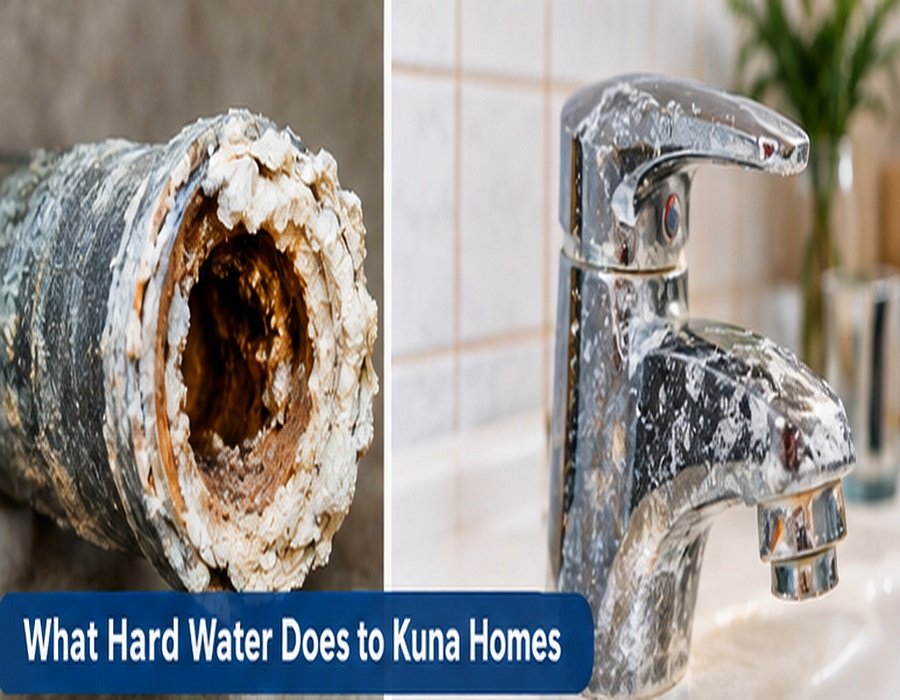
Kuna’s water is hard because it comes from groundwater wells. As water moves through southern Idaho’s soil and rock, it dissolves calcium and magnesium. The City of Kuna draws from 9 municipal wells, and the minerals come along for the ride.
You can review the city’s numbers yourself in the official City of Kuna Water Quality Reports. The report states plainly that hard water is not a health risk. It is a plumbing and appliance problem.
Water Hardness Scale (Where Kuna Lands)
| Hardness Level | Grains Per Gallon (gpg) | mg/L (ppm) | What You’ll Notice |
|---|---|---|---|
| Soft | Under 1.0 | Under 17.1 | No scale, soap lathers easily |
| Slightly Hard | 1.0 to 3.5 | 17.1 to 60 | Minor spotting on glass |
| Moderately Hard | 3.5 to 7.0 | 60 to 120 | Visible scale on faucets |
| Hard (Kuna: 8.05 gpg) | 7.0 to 10.5 | 120 to 180 | Crusty fixtures, scaled water heaters, dry skin |
| Very Hard | Over 10.5 | Over 180 | Rapid scale buildup, appliance failure |
Key Facts From Kuna’s Consumer Confidence Report
| Item | Kuna Data | What It Means for a Softener |
|---|---|---|
| Average hardness | 8.05 gpg / 137.73 mg/L | Softener strongly recommended |
| Water source | Groundwater wells | Hardness stays consistent year-round |
| Fluoride added | No | No impact on softener choice |
| Chlorine (average) | 0.382 mg/L | Low levels, gentle on resin |
| Arsenic (highest detected) | 0.008 mg/L (limit is 0.010) | Softeners do not remove arsenic; add reverse osmosis if concerned |
That last row matters. A softener removes hardness minerals. It is not a filter for arsenic, nitrate, or bacteria. If you want both, we pair the softener with an under-sink reverse osmosis (RO) system for drinking water. Start your planning for Water Softener Installation Kuna ID by pulling your neighborhood’s latest report and noting the hardness number.
What Hard Water Does to Kuna Homes
Hard water builds scale, a chalky mineral crust that forms when heated or evaporated water leaves calcium behind. On recent service calls in Kuna, our plumbers have pulled pounds of scale out of 6-year-old tank water heaters. We also see pinhole leaks at scaled fittings and tankless heaters throwing error codes from clogged heat exchangers.
The damage is gradual, so most homeowners don’t notice until something fails. By then, the repair bill is usually bigger than the softener would have been.
Appliance Lifespan: Hard Water vs. Softened Water
| Appliance | Typical Life on Hard Water (7+ gpg) | Typical Life on Softened Water | Common Hard Water Failure |
|---|---|---|---|
| Tank water heater | 6 to 8 years | 10 to 15 years | Sediment buildup, burned-out elements |
| Tankless water heater | 10 to 12 years (with frequent descaling) | 18 to 20 years | Scaled heat exchanger, flow errors |
| Dishwasher | 6 to 8 years | 9 to 12 years | Clogged spray arms, film on dishes |
| Washing machine | 7 to 9 years | 10 to 13 years | Scaled valves, stiff laundry |
| Faucets & showerheads | 3 to 5 years before replacement | 8+ years | Reduced flow, crusty aerators |
Independent testing by the Battelle Memorial Institute found that gas storage water heaters on softened water held their original efficiency, while units on hard water lost efficiency over time. That loss shows up directly on your gas bill. If your heater is already struggling, our water heater installation team can replace it and set up a softener in the same visit.
Warning Signs You Need a Softener
- White crust on faucets, showerheads, and glass shower doors
- Spotty dishes even after a full dishwasher cycle
- Popping or rumbling sounds from your water heater
- Dry, itchy skin and dull hair after showering
- Stiff, faded laundry despite using extra detergent
- Low water pressure at individual fixtures
Check your showerhead tonight: if the nozzles are crusted white, scale is building throughout your plumbing.
Check Also: How Repiping Nampa ID Homes Stops Leaks, Restores Water Pressure, and Protects Your Budget
Types of Water Softeners for Kuna Homes
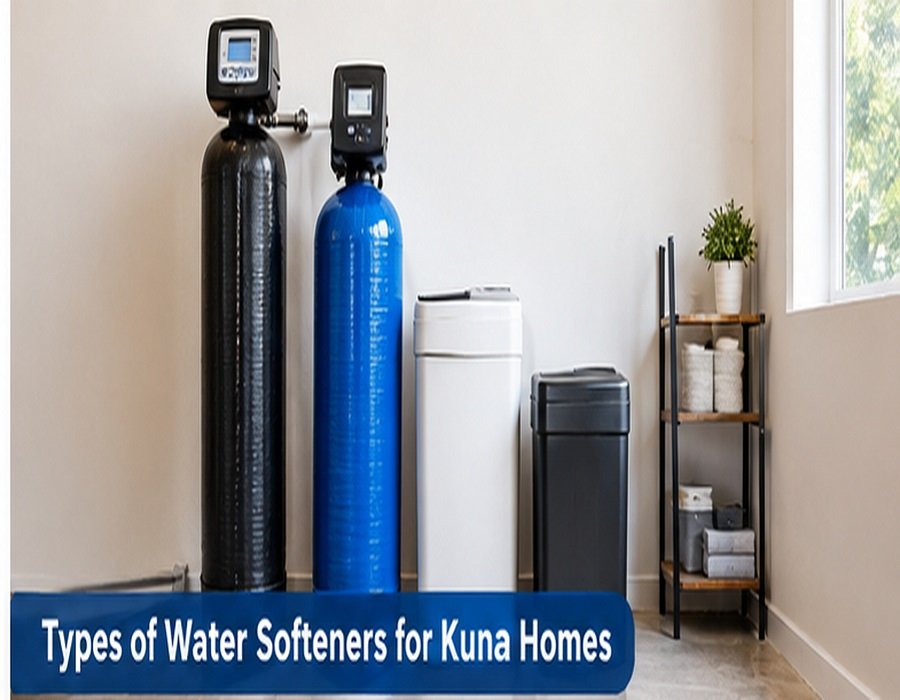
A water softener is a system that removes or neutralizes hardness minerals. The right type depends on your household size, budget, and whether you want true softening or just scale prevention. Our crews install all four types below, and each one fits a different situation in Water Softener Installation Kuna ID projects.
Water Softener Types Compared
| Type | How It Works | Removes Hardness? | Uses Salt? | Best For |
|---|---|---|---|---|
| Salt-based ion exchange | Resin beads swap calcium/magnesium for sodium | Yes, fully | Yes | Most Kuna homes |
| Dual-tank ion exchange | Two resin tanks alternate, giving 24/7 soft water | Yes, fully | Yes | Large families, high usage |
| Salt-free conditioner (TAC) | Template Assisted Crystallization changes minerals so they don’t stick | No, prevents scale only | No | Low-maintenance or sodium-restricted homes |
| Potassium-based ion exchange | Same as salt-based, but uses potassium chloride | Yes, fully | Uses potassium instead | Homes avoiding added sodium |
Salt-Based Ion Exchange: Pros and Cons
Pros:
- Removes 100% of hardness at Kuna’s 8 gpg level
- Proven technology with 20+ year track records
- Noticeably softer skin, hair, and laundry
- Best protection for tankless water heaters
Cons:
- Requires salt refills every 4 to 8 weeks
- Uses water during regeneration (the cleaning cycle that recharges the resin)
- Adds a small amount of sodium to water
- Needs a drain connection and electrical outlet
Salt-Free Conditioner: Pros and Cons
Pros:
- No salt, no regeneration water, no drain line needed
- Very low maintenance
- No added sodium
Cons:
- Water stays technically hard: no slippery “soft water” feel
- Soap and detergent still won’t lather like soft water
- Less effective on spotting and water heater scale at higher hardness levels
If you want spot-free dishes and softer laundry, choose salt-based ion exchange. If you only want scale prevention with zero upkeep, a TAC conditioner is the better fit.\
How to Size a Water Softener for Kuna Water
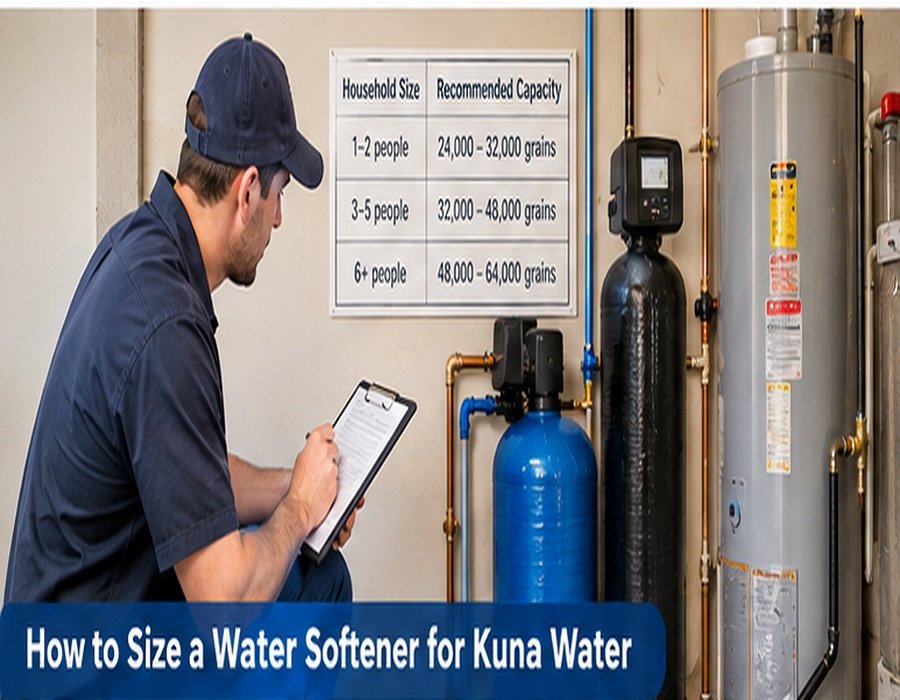
Softener size is measured in grain capacity, the total hardness the resin can remove before it regenerates. An undersized unit regenerates too often and wastes salt and water. An oversized unit lets the resin sit too long and can cause channeling (water carving paths through the resin bed).
Here’s the sizing formula our technicians use:
- Multiply the number of people in your home by 75 gallons (average daily use per person).
- Multiply that total by your water hardness (8.05 gpg in Kuna; round to 8).
- Multiply by 7 days to get weekly grain demand.
- Choose a softener that covers that demand with room to spare.
Kuna Softener Sizing Chart (Based on 8 gpg)
| Household Size | Daily Grains Removed | Weekly Grains Removed | Recommended Softener Size |
|---|---|---|---|
| 1 to 2 people | 1,200 | 8,400 | 24,000 grain |
| 3 people | 1,800 | 12,600 | 32,000 grain |
| 4 people | 2,400 | 16,800 | 32,000 to 40,000 grain |
| 5 people | 3,000 | 21,000 | 40,000 to 48,000 grain |
| 6+ people | 3,600+ | 25,200+ | 48,000 to 64,000 grain |
Homes on private wells outside Kuna city limits often carry iron as well. Each 1 ppm of iron adds roughly 3 to 5 gpg to your sizing number. We always test well water on-site before recommending a size.
For accurate Water Softener Installation Kuna ID sizing, count your household members and check whether you’re on city water or a private well before you request a quote.
Water Softener Installation Cost in Kuna, ID
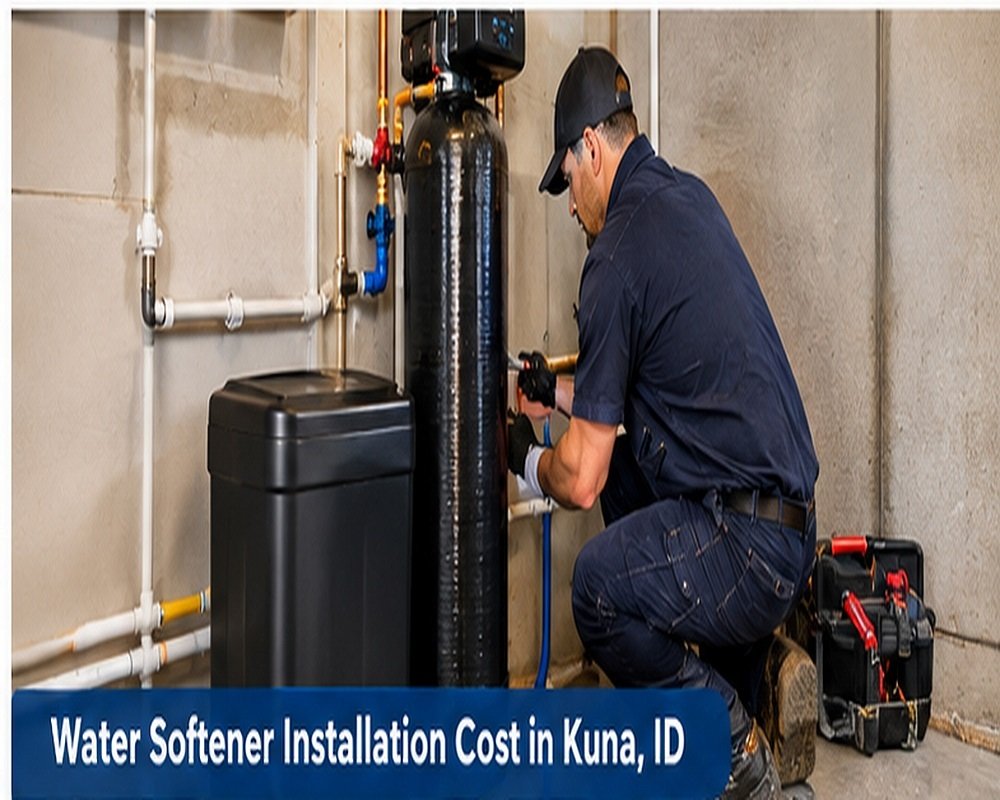
Installed cost depends on equipment type, plumbing access, and whether your home has a pre-plumbed softener loop. Most Kuna homes built after 2000 include a loop in the garage or utility room, which cuts labor significantly. Older homes and some rural properties need new piping, a drain line, and sometimes an outlet.
At Meridian Plumbing Services, we give upfront, flat-rate pricing before any work starts. No surprise line items.
Cost Comparison: Installed Price Ranges (2026 Treasure Valley Estimates)
| System Type | Equipment Cost | Installation Labor | Total Installed Cost |
|---|---|---|---|
| Salt-based, single tank (32k to 48k grain) | $900 to $2,200 | $350 to $800 | $1,250 to $3,000 |
| Dual-tank ion exchange | $2,000 to $3,800 | $500 to $1,000 | $2,500 to $4,800 |
| Salt-free conditioner (TAC) | $1,000 to $2,800 | $350 to $700 | $1,350 to $3,500 |
| Softener + under-sink RO combo | $1,500 to $3,500 | $500 to $1,100 | $2,000 to $4,600 |
Add-On Costs to Plan For
| Add-On | Typical Cost | When It’s Needed |
|---|---|---|
| New softener loop | $500 to $1,500 | Homes without pre-plumbed connections |
| Drain line + air gap | $150 to $400 | No floor drain or standpipe nearby |
| New electrical outlet | $150 to $350 | No outlet within reach of the unit |
| Bypass valve | $50 to $150 | Usually included; required for service |
| Pre-filter (sediment) | $100 to $300 | Private wells with sand or sediment |
| Removal of old unit | $75 to $200 | Replacing an existing softener |
Annual Operating Costs
| Expense | Salt-Based System | Salt-Free System |
|---|---|---|
| Salt or potassium | $80 to $200/year (salt) or $250 to $500/year (potassium) | $0 |
| Regeneration water | 1,500 to 4,000 gallons/year | 0 gallons |
| Electricity | $5 to $15/year | $0 |
| Filter/media replacement | Resin every 10 to 15 years | Media every 3 to 6 years |
Get a written, itemized quote that lists equipment model, grain capacity, and every add-on before you sign
Our Water Softener Installation Process
A professional installation takes 3 to 5 hours for most homes with an existing loop. Homes needing a new loop or drain usually take a full day. Our plumbers follow the same checklist on every job.
- Test your water hardness, iron, and pH on-site.
- Confirm the right grain capacity using your household size.
- Shut off the main water supply and drain the lines.
- Install a bypass valve so you can service the unit without losing water.
- Connect inlet and outlet lines to the softener loop.
- Run the drain line to a floor drain or standpipe with a proper air gap (a physical space that prevents wastewater from backing into your supply).
- Plug in the control valve and program regeneration settings for 8 gpg.
- Fill the brine tank with salt and run a manual regeneration.
- Check every connection for leaks under full pressure.
- Test softened water at a faucet to confirm 0 to 1 gpg output.
Code and Permit Points Kuna Homeowners Should Know
- Air gap on the drain line is required under the plumbing code. A hose shoved into a drain is a cross-connection risk.
- Plumbing permits may apply when new piping or a new loop is added. We handle permits when required.
- Backflow protection matters in Kuna. The city already requires annual backflow testing on irrigation systems, so treat any cross-connection seriously.
- Septic systems: Many rural Kuna homes are on septic. A properly sized, efficient softener with metered regeneration keeps brine discharge to a minimum.
Winter Placement: The Kuna-Specific Mistake We See Most
If you’ve spent a winter in Idaho, protecting your water equipment makes complete sense. Kuna temperatures regularly fall into the teens in December and January. A softener in an uninsulated garage can freeze overnight. Frozen control valves crack, and cracked valves flood garages.
Our winter placement rules:
- Install indoors in a utility room, basement, or insulated garage whenever possible.
- Insulate exposed inlet, outlet, and drain lines.
- Keep the garage door closed during cold snaps.
- Add a small heat source or pipe heat tape in borderline spaces.
If you suspect a slow leak around an older unit, our leak detection service can find it before it soaks your drywall or subfloor.
Water Efficiency Ratings: Choosing a Low-Waste Softener
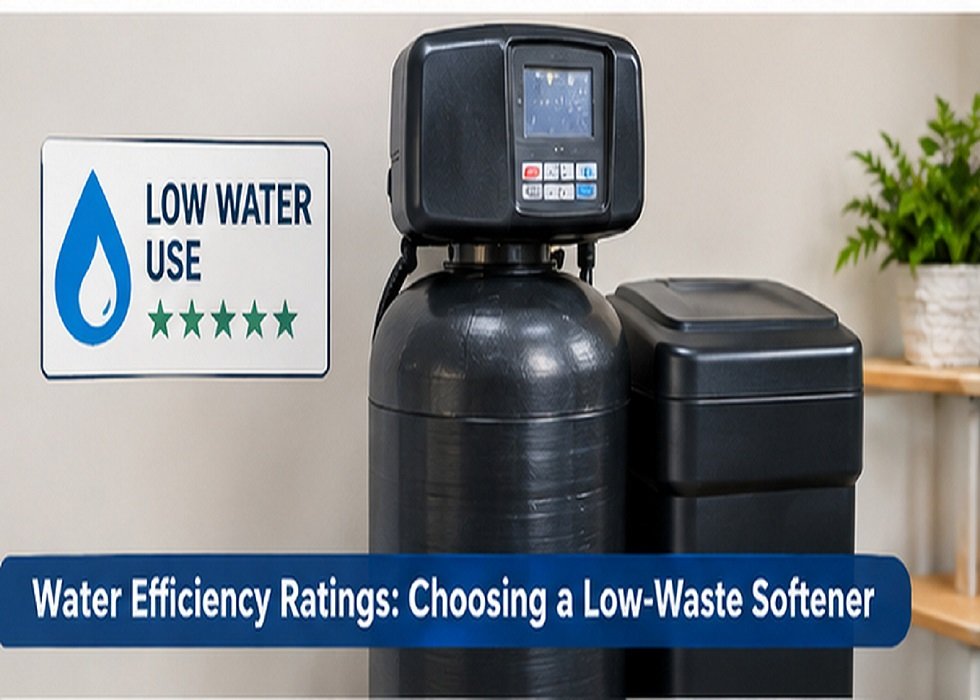
Softener efficiency measures how much salt and water the unit uses per grain of hardness removed. Efficient softeners save money every month and reduce brine sent to the sewer or septic tank. Look for NSF/ANSI Standard 44 certification, the industry benchmark for softener performance.
Under NSF/ANSI 44, a softener qualifies for an efficiency rating only if it removes at least 3,350 grains per pound of salt and uses no more than 5 gallons of water per 1,000 grains removed.
Regeneration Methods Compared
| Regeneration Type | How It Triggers | Salt Use | Water Use per Year (Family of 4) | Our Recommendation |
|---|---|---|---|---|
| Timer-based | Fixed schedule (e.g., every 3 days) | High | 4,000 to 6,000 gallons | Avoid for new installs |
| Metered (demand-initiated) | After set gallons are used | 30% to 40% less | 2,000 to 3,000 gallons | Best value for most homes |
| Metered + upflow brining | Demand-based, brine flows upward | Up to 50% less | 1,500 to 2,500 gallons | Best efficiency |
| Dual-tank alternating | Demand-based, one tank always online | Low | 1,800 to 2,800 gallons | High-use households |
Softening also pairs well with water-saving fixtures. The EPA WaterSense program labels faucets, showerheads, and toilets that use at least 20% less water. Soft water keeps those low-flow aerators from clogging, so they keep saving water for years. For Water Softener Installation Kuna ID projects, we recommend a metered softener with NSF 44 certification as the baseline.
Ask any installer for the NSF 44 certificate number and the gallons-per-regeneration spec before you buy.
Water Softener Maintenance Checklist
A softener is low-maintenance, not no-maintenance. Ten minutes a month keeps the resin, brine tank, and control valve working. Most failures we repair trace back to skipped maintenance.
Monthly
- Check the salt level. Keep the brine tank at least one-quarter full.
- Look for salt bridges (a hard crust that forms above the water, blocking salt from dissolving). Break it up with a broom handle.
- Inspect connections for drips or moisture.
Every 3 to 6 Months
- Test your water with hardness strips. Softened water should read 0 to 1 gpg.
- Clean the venturi valve (the small nozzle that draws brine into the resin tank).
- Verify the clock and settings after any power outage.
Every Year
- Clean the brine tank and remove salt mush at the bottom.
- Add resin cleaner if you’re on a well with iron.
- Schedule a professional inspection of the control valve, seals, and drain line.
Every 10 to 15 Years
- Replace the resin bed or the full unit, depending on control valve condition.
Best Salt Types for Kuna Softeners
| Salt Type | Purity | Cost (40 lb bag) | Our Take |
|---|---|---|---|
| Evaporated pellets | 99.9% | $7 to $10 | Best choice, least residue |
| Solar salt crystals | 99.5% | $6 to $9 | Good, slightly more residue |
| Rock salt | 95% to 98% | $5 to $7 | Avoid, leaves sediment in the tank |
| Potassium chloride | 99%+ | $25 to $40 | Sodium-free, but costs 3 to 4x more |
Keeping up with this list is the cheapest way to protect your investment after Water Softener Installation Kuna ID work is complete. Set a monthly phone reminder to check the salt level today.
Troubleshooting Common Water Softener Problems
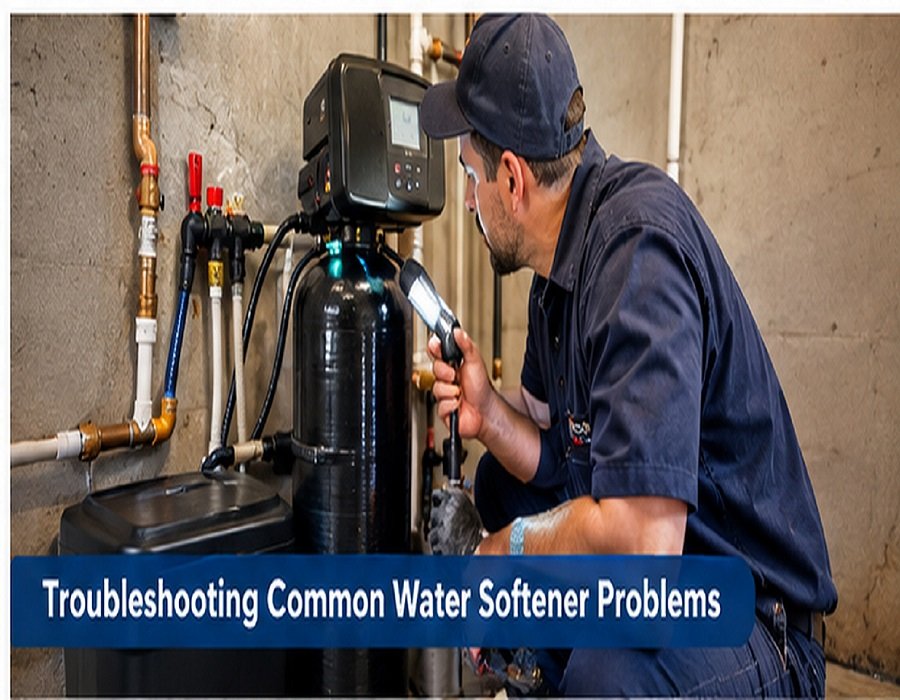
Most softener issues have simple causes. Work through these steps before calling for service.
Steps to Troubleshoot Hard Water Returning
- Check the salt level. An empty brine tank is the number one cause.
- Break up any salt bridge sitting above the water line.
- Confirm the bypass valve is in the “service” position, not “bypass.”
- Reset the clock if the power went out recently.
- Verify the hardness setting is programmed at 8 gpg or higher.
- Run a manual regeneration and retest the water after 2 hours.
Quick Problem-Solution Table
| Problem | Likely Cause | Fix |
|---|---|---|
| Water feels hard again | Empty salt, salt bridge, wrong setting | Refill, break bridge, reprogram |
| Brine tank full of water | Clogged venturi or drain line | Clean venturi, clear drain line |
| Salty taste | Too much brine, clogged drain | Check brine setting and drain flow |
| Low water pressure | Clogged resin or pre-filter | Replace pre-filter, clean or replace resin |
| Unit runs constantly | Stuck control valve or bad motor | Call a plumber for valve repair |
| Water leaking near unit | Cracked valve, loose fittings, freeze damage | Shut off at bypass, call for service |
Slow drains in a softened home are rarely the softener’s fault. Years of hard water scale and soap buildup inside pipes can linger. Our drain cleaning service clears that residue so your new soft water flows freely.
Repair vs. Replace: When to Upgrade Your Softener
The control valve is the brain of the softener, and the resin is the engine. Repairing makes sense when one part fails on a younger unit. Replacement makes sense when the unit is old, inefficient, or needs multiple major parts.
Our crews frequently see 15- to 20-year-old timer-based softeners in older Kuna and Boise homes. These units still “work,” but they waste thousands of gallons of water a year compared to modern metered models.
Repair vs. Replace Decision Table
| Situation | Unit Age | Typical Repair Cost | Recommendation |
|---|---|---|---|
| Clogged venturi or injector | Any age | $100 to $250 | Repair |
| Failed motor or timer | Under 10 years | $200 to $450 | Repair |
| Worn seals and spacers | Under 12 years | $150 to $350 | Repair |
| Resin bed exhausted | 10 to 15 years | $300 to $600 | Repair if valve is solid; otherwise replace |
| Cracked control valve | Over 10 years | $400 to $900 | Replace |
| Cracked resin tank | Any age | $500+ | Replace |
| Timer-based unit, multiple issues | Over 15 years | $600+ combined | Replace with metered model |
Our rule of thumb: if the repair costs more than 50% of a new unit and the softener is over 10 years old, replace it. Schedule a service visit and ask for both a repair quote and a replacement quote side by side.
FAQs
Do I really need a softener if Kuna’s water is safe to drink?
Yes, if you want to protect your appliances and plumbing. Kuna’s water is safe, but at 8.05 gpg it builds scale that shortens water heater and fixture life.
Will a softener remove arsenic or nitrate?
No. Softeners remove calcium and magnesium only. Pair your softener with reverse osmosis at the kitchen sink for drinking water treatment.
How much sodium does softened water add?
At 8 gpg, softened water adds roughly 60 to 65 mg of sodium per quart. That’s less than a slice of bread. If you’re on a sodium-restricted diet, use potassium chloride or an RO system for drinking water.
Can I install a softener myself?
Experienced DIYers can, but common mistakes include missing air gaps, wrong sizing, and freeze-prone placement. Professional installation also protects your manufacturer warranty.
How long does a water softener last?
A quality softener lasts 10 to 20 years. The resin typically needs replacement around year 10 to 15.
Is softened water OK for houseplants and lawns?
Use unsoftened water for plants. We typically leave outdoor hose bibs and irrigation lines on hard water.
Should my kitchen cold tap be softened?
That’s your choice. Many Kuna homeowners soften the whole house and add RO at the kitchen sink for drinking and cooking.
How soon will I notice a difference?
Within 24 hours at the tap. Existing scale in pipes and fixtures fades gradually over several weeks.
Your Next Step: Schedule a Kuna Water Test
A softener is a long-term investment in your plumbing. The right system, sized for Kuna’s 8.05 gpg water and installed where it won’t freeze, protects your water heater, fixtures, and appliances for well over a decade. The wrong system wastes salt, water, and money.
At Meridian Plumbing Services, we bring transparent pricing, plain-language recommendations, and 7-days-a-week service to every job. We test your water on-site, size the unit correctly, and show you the full cost before we start. No pressure, no jargon, just honest numbers.
Call Meridian Plumbing Services today to book a free on-site hardness test and get a written quote for Water Softener Installation Kuna ID at your home.